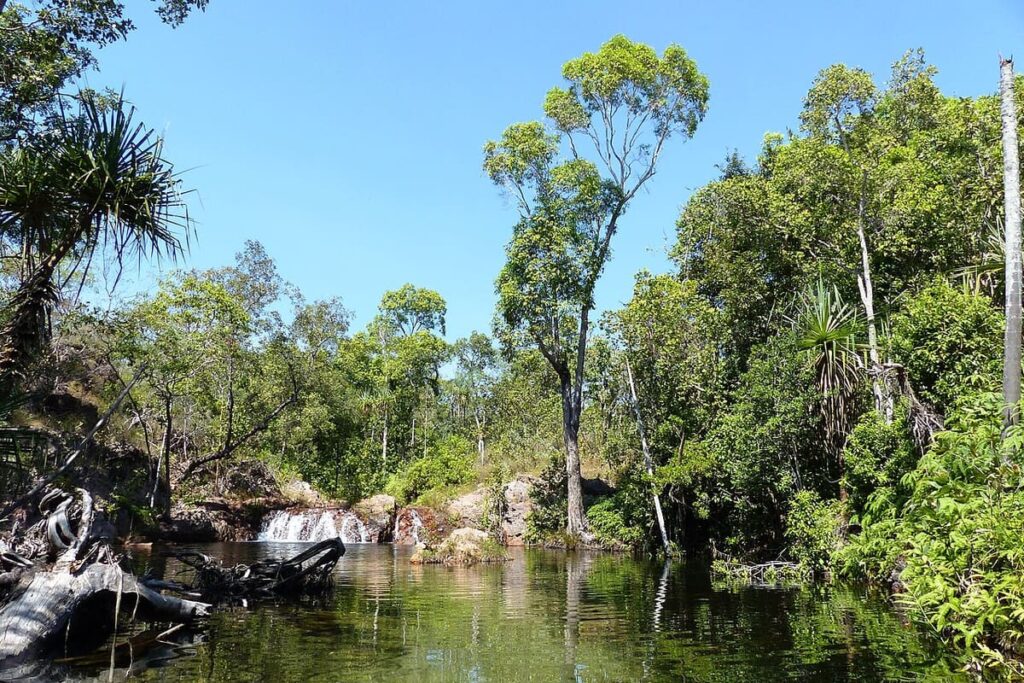
About Litchfield NP
A quieter alternative to Kakadu near Darwin — Florence and Wangi waterfalls, swimming pools below the falls, magnetic termite mounds.
Litchfield NP sits in Northern Territory, Australia, near Batchelor and about 3076 km from the capital, Canberra. Plan your visit for May-Oct — that’s when Litchfield NP is at its best, with the most reliable conditions and the easiest logistics.
This guide covers what makes Litchfield NP worth a trip, how to get there, what it costs, what to take, and the safety basics. Use the table of contents to jump to what you need, or read end-to-end to plan a full visit.
How to get to Litchfield NP
The closest base for Litchfield NP is Batchelor. Most travellers arrive via a regional flight to the nearest airport, then continue overland (taxi, bus or hire car) to the trailhead or visitor area. International flights to Australia usually route through the country’s main hub, Canberra, before connecting onward.
If you’re combining Litchfield NP with other stops in Australia, browse the Australia attractions hub for ideas — and use the Trip Planner to chain them into a single route.
Best time to visit Litchfield NP
The best time to visit Litchfield NP is generally May-Oct. That window offers the most reliable conditions, the safest access and the most consistent visitor services. Shoulder months either side of this window are often the sweet spot — quieter, cheaper, and only slightly less perfect.
Plan your visit for May-Oct — that’s when Litchfield NP is at its best, with the most reliable conditions and the easiest logistics. Check current local forecasts close to your departure, and read our wider national parks season notes on the National Parks hub.
Entry fee & opening hours
Entry fee: Free to visit. Open access — no formal opening hours.
Fees and hours can change with season, advisory status or maintenance. Always confirm via the official park / operator website before you set out.
Things to do at Litchfield NP
- National Park-focused exploring: make your way to the main vantage point first — it’s usually the easiest and most rewarding stretch of the visit.
- Photography: dawn and the last hour before sunset deliver the best light. Bring a wide lens for the landscape and a longer one for detail.
- Local experience: a guided walk with a regional guide adds context you won’t pick up alone, and supports the local economy.
- Day trips: see the What’s nearby section below — most visitors pair Litchfield NP with at least one or two other stops in the same trip.
Safety tips
Litchfield NP is rated easy. The walk-in, paths and physical demand are well within the reach of most travellers in normal health.
- Read your country’s current travel advisory for Australia before you go — see our travel advisories digest.
- Buy comprehensive travel insurance with adventure-activity cover. SafetyWing is an easy option you can buy after departure.
- Tell someone your route and expected return time — especially for hikes, caves and remote attractions.
- Carry water, snacks and a backup light source. Phone batteries die fast in cold or remote conditions.
- Respect cordons, fences and posted warnings — they are usually there because someone got hurt.
What to carry
- Comfortable walking shoes broken in beforehand (boots for trails, sturdy trainers for short walks)
- 1–2 L of water per person and high-calorie snacks
- Layered clothing (a warm mid-layer, a waterproof shell) — even in warm climates, weather changes fast at altitude or near water
- Sun cover: high-SPF sunscreen, hat, sunglasses
- A power bank, a headlamp + spare batteries, and a small first-aid kit
- Cash in small denominations — ATMs are unreliable in remote areas
- Camera with a wide-angle lens, plus a lens cloth (mist and spray love camera glass)
What NOT to carry / do
- Single-use plastics — many national parks have banned them; refillable bottles only
- Drones without an explicit permit — most parks and many countries prohibit them
- Food into wildlife areas — even an apple core teaches animals to associate humans with food
- Loud Bluetooth speakers — they wreck the experience for every other visitor
- Anything you wouldn’t carry up an emergency stairwell — be honest about your fitness
Suggested itinerary
Half-day visit (4–5 h): Drive in from Batchelor, walk the main viewpoint loop, eat lunch, return.
Full-day visit (8–10 h): Early start from Batchelor, longer loop or second viewpoint, lunch, a guided activity in the afternoon, return for sunset.
Overnight (1–2 nights): Stay in or near Batchelor, hit Litchfield NP at sunrise and sunset for the best light, and use the middle of the day to explore nearby spots — see What’s nearby below.
Budget estimate
On a budget, Litchfield NP is very doable. Local buses, guesthouse-grade beds and street food keep daily costs low. A rough per-person budget for a one-day visit from Batchelor:
- Transport (round trip): US$10–30
- Entry fee: Free
- Guide / activity (optional): US$15–40
- Food & water: US$8–20
Use the Budget Calculator to build a full trip-level estimate.
Litchfield NP works well for families. Trails and access are manageable for older children, and the experience scales down nicely for shorter visits.
Frequently asked questions
Where is Litchfield NP?
What is the best time to visit Litchfield NP?
How much does it cost to visit Litchfield NP?
Is Litchfield NP family-friendly?
How do I get to Litchfield NP?
What should I pack for Litchfield NP?
Map & location
Travel safely. Buy comprehensive travel insurance before you go — SafetyWing covers most countries and you can buy after you’ve already left.
Get a quote →