For roughly 1,400 years, no one on Earth could read a single Egyptian hieroglyph. The last person who could write them died sometime around 394 AD. After that, one of the great written languages of the ancient world became just decoration — pretty pictures on the walls of temples nobody could understand.
The reopening of Egyptian history is one of the great intellectual detective stories, and it turns on a single black rock and a French kid who taught himself Coptic when he was eleven. Start with our complete history of ancient Egypt for context.
Why hieroglyphs went dark
Egyptian was still being written in various scripts (hieratic, demotic, later Coptic) throughout Ptolemaic and Roman times. But hieroglyphs — the formal picture-writing used on temple walls and monumental inscriptions — were only ever known by a specialist priestly caste. When the Roman emperor Theodosius closed pagan temples in 391 AD, the training pipeline collapsed within a generation.
The last known hieroglyphic inscription was carved at Philae in 394 AD. After that, the meaning was lost. Medieval Arab scholars made attempts — some of them very serious — but nobody had the key.
The prevailing theory in Renaissance Europe (based on a corrupted 5th-century Greek text by Horapollo) was that hieroglyphs were purely symbolic — a sort of mystical picture-code where every image stood for a spiritual concept. This was completely wrong, and it wasted the effort of several centuries of scholars including the polymath Athanasius Kircher, who published beautiful and confident translations that turn out to be nonsense.
The stone gets found
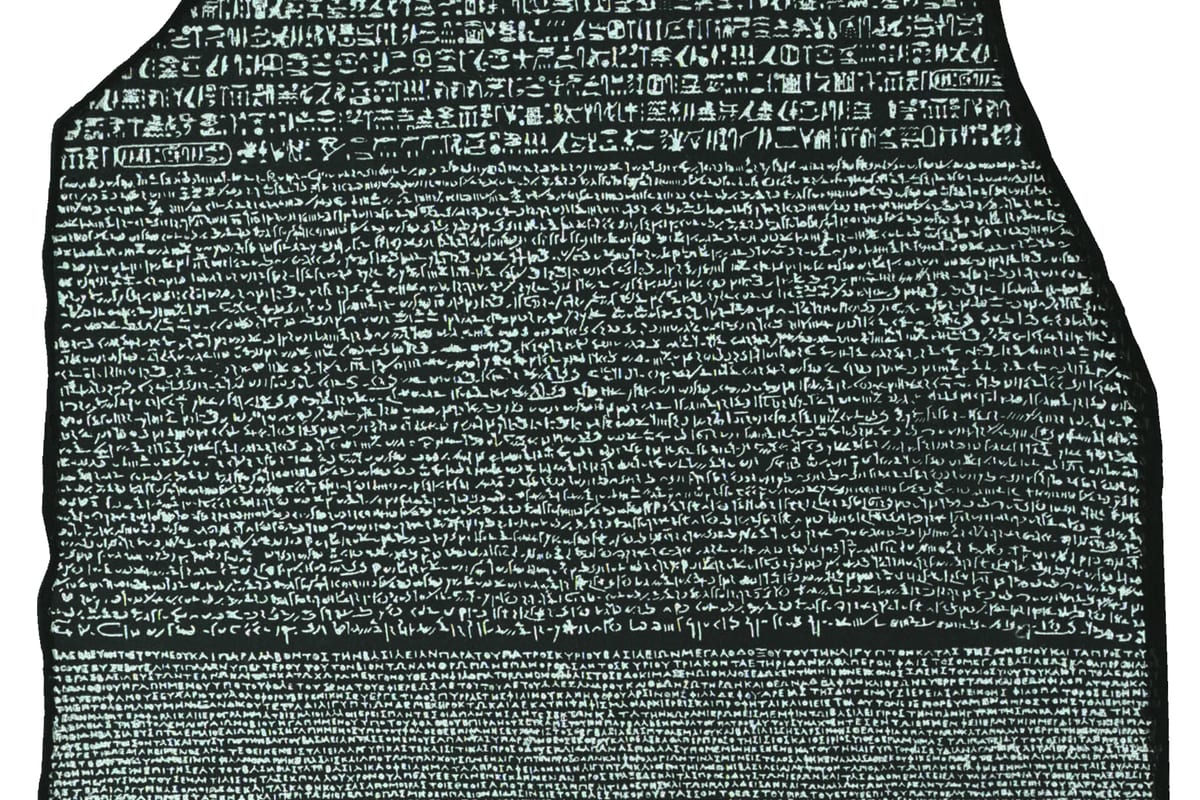
In July 1799, Napoleon Bonaparte’s French army was digging fortifications at a place called Rosetta (modern Rashid) in the western Nile delta. A young lieutenant named Pierre-François Bouchard noticed that one of the stones being reused in the fortifications was a large slab of black granite (actually granodiorite) covered in three registers of writing.
Napoleon’s Egypt expedition had brought along about 150 scholars — engineers, artists, linguists, scientists — precisely because he understood the country’s cultural weight. Bouchard immediately understood the stone might be important and shipped it back to the scholars in Cairo.
They quickly recognised what they had. The three registers were the same text repeated in three scripts: Greek at the bottom, demotic in the middle, and hieroglyphs at the top. The text turned out to be a fairly boring priestly decree from 196 BC, praising the young pharaoh Ptolemy V for his tax breaks to temples. But because it was the same text in three scripts, and because one of those scripts (Greek) was perfectly readable, it was a potential Rosetta stone — the pun that has since gone into every language on Earth.
The British get it
In 1801 the French army in Egypt was defeated by the British. Under the terms of the Treaty of Alexandria, all the antiquities collected by the French were handed over to Britain, including the stone. It arrived at the British Museum in 1802 and has stayed there ever since — currently the most-visited object in the entire museum, behind glass in the Egyptian gallery, with a permanent crowd around it.
Egypt has repeatedly requested its return, most recently through official channels in 2022. Britain has declined.
The race to decode
Casts and copies of the stone were made and circulated to scholars across Europe. Two men led the race.
Thomas Young was an English polymath — physician, physicist, philologist. In 1814-1819 he made real progress. He noticed that certain groups of hieroglyphs were enclosed in oval loops (later called cartouches) and correctly guessed these were royal names. Working from the Greek text on the stone, which named Ptolemy V, he identified the hieroglyphs for “P-T-O-L-M-Y-S” — proving that hieroglyphs, at least sometimes, were phonetic and not just symbolic.
Jean-François Champollion was a young Frenchman who had been obsessed with Egypt since he was a child. By age eleven he had taught himself Coptic (correctly recognising it as the last stage of the Egyptian language), and by age 22 he was writing academic papers on Egyptian history. He built on Young’s work and did what Young could not — he made the final leap.
Champollion’s breakthrough
The decisive moment came on 14 September 1822. Champollion had been working with a cartouche from the Abu Simbel temple, containing what he thought might be the name of Ramses II. The cartouche read (roughly) a sun disc + an unknown squiggle + M + S. Champollion knew from Coptic that the Egyptian word for “sun” was Ra. So the cartouche read: Ra + unknown + M + S — potentially “Ra-M-S-S” — Ramses.
The trick was that Champollion realised the hieroglyphs were not just phonetic for foreign names (like Ptolemy) but for native Egyptian names too. That meant hieroglyphs were a working phonetic script — not a mystical code, but a language that could be read.
According to family lore, Champollion sprinted from his study across Paris to his brother’s office at the Institut, burst in shouting “Je tiens l’affaire!” (“I’ve got it!”), and collapsed unconscious for five days from exhaustion. His formal paper — the Lettre à M. Dacier — was read to the Académie des Inscriptions on 27 September 1822. Egyptology as a discipline is dated from that day.
What decoding hieroglyphs unlocked
Hieroglyphs are a mixed script — partly phonetic (like an alphabet), partly logographic (like Chinese), partly determinative (silent classifiers that tell you what category of word you’re reading). About 700 signs were in regular use.
Once Champollion had cracked the system, the temple walls of Egypt suddenly started talking. Within a decade, scholars could read the histories of pharaohs, the poetry of scribes, the medical papyri, the Book of the Dead, the diplomatic correspondence of Ramses II. Everything Herodotus and Manetho had told the Greeks about Egypt could now be checked against Egyptian sources. Whole dynasties were reconstructed. It is one of the largest single expansions of human historical knowledge that has ever happened.
Champollion himself finally travelled to Egypt in 1828-29, reading temple inscriptions with his own eyes for the first time. He died in 1832 aged 41, exhausted.
Where to see it today
- British Museum, London: the Rosetta Stone itself, permanent display in Room 4
- Grand Egyptian Museum, Cairo: replica of the Rosetta Stone plus extensive hieroglyphic inscriptions
- Philae temple, near Aswan: the site of the last known hieroglyphic inscription (394 AD) is still visitable
- Abu Simbel: the Ramses cartouches Champollion used are still on the temple walls where he read them
- Karnak and Luxor: the two largest concentrations of hieroglyphic text still standing in Egypt
See our Egypt guide, best time to visit and Nile cruise guide.
Frequently asked questions
What is the Rosetta Stone?
Who found the Rosetta Stone?
Who decoded Egyptian hieroglyphs?
Why can’t Egypt have the Rosetta Stone back?
How does the hieroglyphic writing system actually work?
When was the last hieroglyphic inscription written?