For 2,000 years, most educated Europeans thought Homer’s Iliad was a made-up story. Then a rich German amateur named Heinrich Schliemann dug at a hill in northwestern Turkey in 1871, at a hilltop in the Peloponnese in 1876, and turned up remains of two real Bronze Age cities that matched Homer’s descriptions in striking ways. Since then, 150 years of professional archaeology have gradually filled in a real Bronze Age world behind the Iliad and Odyssey — imperfectly, but recognisably.
Here is what we now think actually happened, and what you can visit today. See our history of ancient Greece for context.
Who the Mycenaeans were
Mycenaean Greeks lived on the Greek mainland from about 1600 to 1100 BC. Their culture developed under strong influence from Minoan Crete (which they eventually invaded and took over around 1450 BC — see our Minoan Crete post). Unlike the Minoans they built massive fortified citadels, wrote in Linear B (an early form of Greek, decoded in 1952 by Michael Ventris), and fought a lot.
The greatest Mycenaean citadels sat on defensible hilltops in the Peloponnese: Mycenae itself (near modern Nafplio), Tiryns (a few kilometres away), Pylos on the west coast, and Argos in the plain below Mycenae. There were similar centres in central Greece at Thebes and Athens (though the Athenian Bronze Age is mostly buried under the Classical city).
The Mycenaean world
Mycenaean society was organised around palaces run by a king (wanax) with an elaborate bureaucracy. Linear B tablets from Pylos and Knossos document a highly centralised economy — the palace controlled crop tithing, textile production, and long-distance trade, with hundreds of specialised occupations recorded. This is the world Homer describes as the “gift-exchange” culture of kings sending elaborate presents to one another.
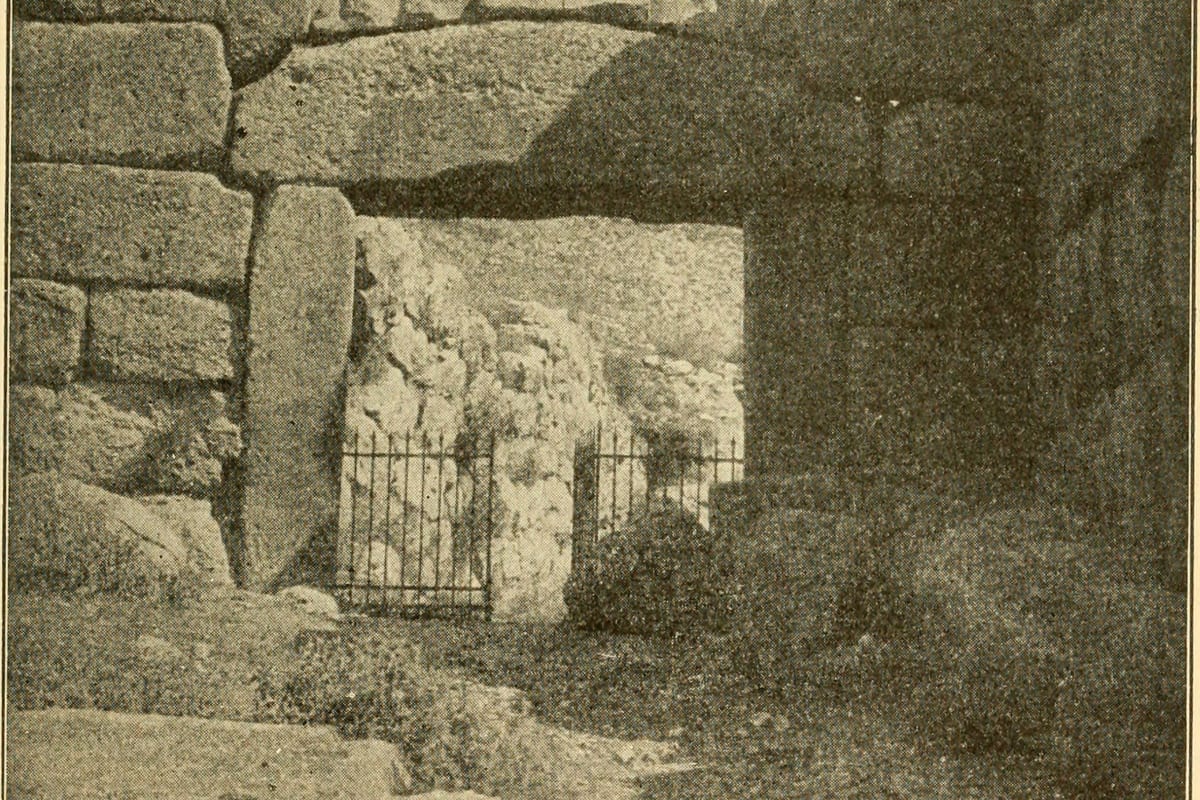
The archaeology at Mycenae itself is dominated by the massive stone walls, the Lion Gate, and the shaft graves excavated by Schliemann in 1876. His discovery of a gold death mask over one of the buried men led him to famously telegraph “I have gazed upon the face of Agamemnon.” (He hadn’t — the mask is 300 years too early — but it was still a hell of a find.)
Troy: the real city under the myth
Troy is a mound called Hisarlik on the western coast of Turkey, about 5 km inland from the Dardanelles. It is not one Bronze Age city but nine cities stacked on top of each other. The Trojan War, if it happened, would have destroyed either Troy VI (destroyed around 1250 BC) or Troy VIIa (destroyed around 1180 BC). Modern archaeologists lean toward Troy VIIa.
The city sat in a strategically important spot — controlling ships passing through the Dardanelles into the Black Sea, taxing the passage. A 10-year siege is not implausible; a coalition of Mycenaean Greek kings sailing to capture a key trading city fits the general geopolitics of the Late Bronze Age eastern Mediterranean.
The Homeric details are less reliable. Achilles, Hector, Helen — we have no confirming evidence any specific person existed. But the general shape of the story — a Greek expedition, a siege, a violent sack of a wealthy trading city on the Anatolian coast, followed by scattered voyages home — fits the archaeological record of about 1200 BC.
The Bronze Age collapse
Whether or not the Trojan War happened, the whole world Homer describes stopped existing around 1200-1100 BC. This is the “Bronze Age Collapse” — one of the most dramatic disasters in world history, when almost every major state in the eastern Mediterranean fell within a few decades. Egypt was severely shaken but survived. The Hittite Empire (of Anatolia) collapsed completely. Ugarit (a wealthy Syrian trading city) was burned and abandoned. Mycenaean Greece collapsed. Cyprus was overrun.
Cause is disputed. Candidates include mass migrations by “Sea Peoples” (mentioned in Egyptian records), climate change (a serious drying trend around 1200 BC), earthquake swarms, systemic collapse of interdependent trade networks, and internal rebellion. Probably all of them at once.
The consequence for Greece was catastrophic. The Mycenaean palaces burned, Linear B writing was lost, population crashed, cities shrank to villages. Greek entered a “Dark Age” of about 300 years, only emerging around 800 BC with a new alphabet borrowed from Phoenicia and no memory of the writing system its ancestors had used. This is when Homer’s epics were probably composed — as oral tradition remembering a lost world, four centuries after that world had ended.
What survives at Mycenae
- The Lion Gate (c. 1250 BC) — the main entrance to the citadel, with a massive lintel supporting a triangular relief of two lions. The oldest monumental sculpture in Europe
- Cyclopean walls — the citadel walls are so massive (blocks up to 20 tonnes) that later Greeks assumed they were built by Cyclopes
- Grave Circle A — the shaft graves where Schliemann found his gold masks and jewellery. All originals are in the National Archaeological Museum in Athens; the site has replicas
- The Treasury of Atreus — a colossal beehive-shaped tomb (tholos) outside the citadel walls, with a 14-metre-tall doorway of massive stone blocks. The largest Bronze Age dome ever built until the Roman Pantheon
- The Palace of Agamemnon — the megaron (throne room) foundations and hearth are still visible on top of the citadel
- Site museum — good context for what you’re seeing
What survives at Troy
- The nine layers of the city — visible in cutaway sections; you can see the different Bronze Age construction levels stacked on top of each other
- The main walls — Troy VI walls, the ones most likely to be Homer’s Troy, still stand up to 10 metres in places
- The main gate — you can walk in through the same gate Bronze Age Trojans used
- The reconstructed Trojan horse — a bit kitsch, but a useful landmark and photo op
- Site museum — new, well-designed, opened 2018 with English signage
How to visit
Both sites are accessible day trips. Mycenae is 2 hours from Athens or 30 minutes from Nafplio (much nicer base). Pair it with Tiryns (10 minutes’ drive) and the theatre of Epidaurus for a classic Peloponnese day.
Troy sits 30 km south of the town of Çanakkale in northwestern Turkey. It is an easy day trip from Çanakkale or a longer one from Istanbul (5 hours’ drive plus ferry). Combine with the Gallipoli battlefields on the other side of the Dardanelles.
See our Greece and Turkey travel guides for planning.
Frequently asked questions
Was the Trojan War real?
Who were the Mycenaeans?
Did Heinrich Schliemann really find the face of Agamemnon?
What was the Bronze Age Collapse?
Can you visit Troy and Mycenae?
Is Homer’s Iliad historically accurate?