Babylon is one of those places where the reality is almost as strange as the myths. The city was real. Nebuchadnezzar was real. The Tower of Babel almost certainly refers to a real ziggurat we can identify. The Hanging Gardens — one of the Seven Wonders of the Ancient World — may or may not have been in Babylon at all.
Here is the honest history, separated from the legends that later Greeks and Bible writers layered on top. For the wider context see our Mesopotamia post.
Where and when
Babylon sat on the Euphrates about 85 km south of modern Baghdad, near the town of Hilla. It was a small provincial city until an Amorite dynasty made it their capital around 1900 BC. Under Hammurabi (1792-1750 BC), Babylon became the political capital of all southern Mesopotamia — the seat of the first Babylonian empire and the source of the famous law code (see our post on Hammurabi’s code).
After Hammurabi, Babylon spent 1,000 years as a wealthy but politically dependent city, ruled by Hittites, Kassites, Assyrians. Its second peak came under Nebuchadnezzar II (605-562 BC), who rebuilt it on a scale never seen before or since in Mesopotamia.
Nebuchadnezzar’s Babylon
Nebuchadnezzar’s city covered about 10 square kilometres — bigger than most modern city centres — protected by triple walls up to 24 metres thick. Herodotus (visiting a century later) claimed a four-horse chariot could turn round on top of the walls. Modern archaeology suggests he exaggerated only slightly.
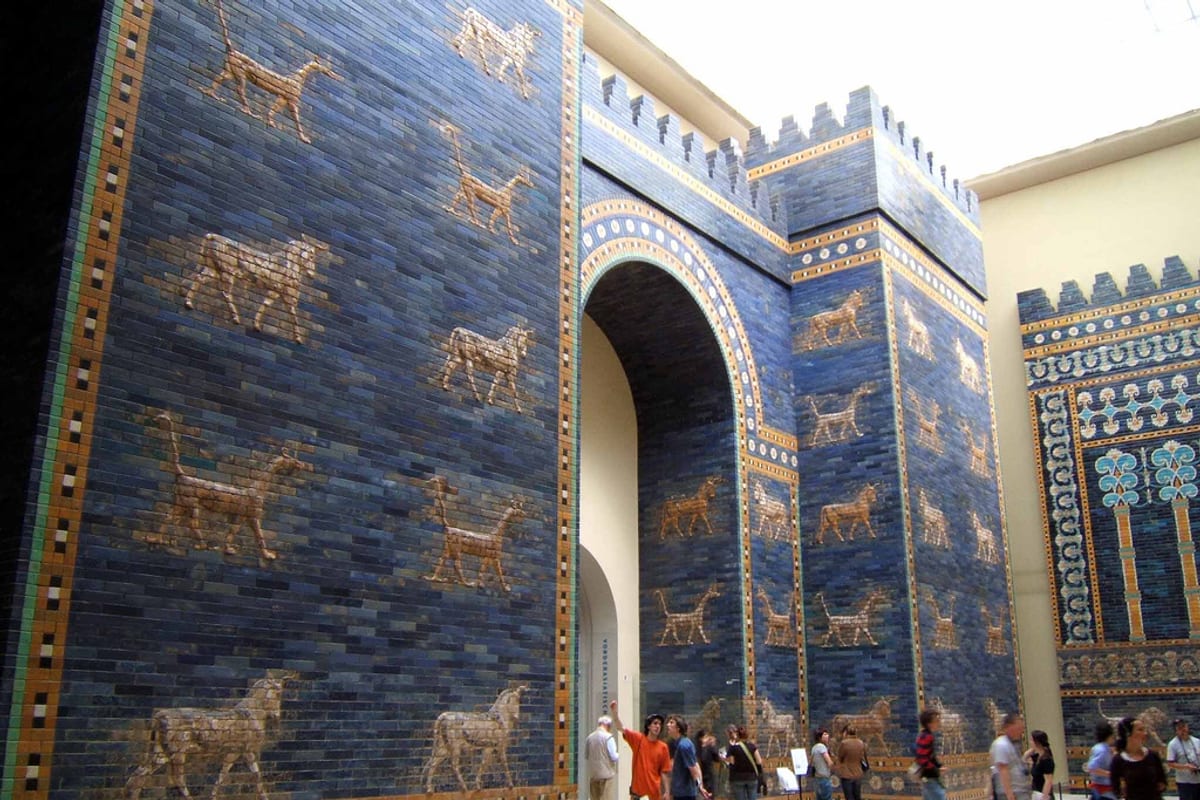
The city had eight main gates named after gods. The Ishtar Gate, the most spectacular, was faced entirely in glazed blue brick, decorated with 575 relief figures of dragons and bulls. It opened onto the Processional Way — a 900-metre road paved with limestone slabs, walled with more glazed brick, along which the statue of Marduk (city god of Babylon) was carried each New Year.
The gate itself was disassembled by German archaeologists between 1902 and 1914 and shipped to Berlin, where it is the centrepiece of the Pergamon Museum. Iraq has repeatedly asked for its return. What remains in Babylon is the gate’s foundations plus a smaller reproduction built during Saddam Hussein’s restoration in the 1980s.
The Tower of Babel
The Book of Genesis describes a tower “whose top may reach unto heaven” that God confused by scattering human languages. This is almost certainly a reference to the great ziggurat of Babylon, called Etemenanki (“temple of the foundation of heaven and earth”). It stood at the centre of Nebuchadnezzar’s city, was built in seven stages, and reached about 90 metres tall — comparable to the Great Pyramid.
Nothing above ground survives. Alexander the Great intended to rebuild Etemenanki after Babylon’s decline; he had his soldiers dismantle the ruins to clear the site, but died before construction began, and the stones were carted off. What remains today is a marshy depression where the tower once stood, ringed by the foundations of an outer wall.
The Hanging Gardens: the puzzle
Now for the interesting problem. The Hanging Gardens are described in colourful detail by Greek and Roman writers from the 4th century BC onwards. They were terraced, elevated, planted with trees and vines, watered by an ingenious lifting mechanism. Attributed to Nebuchadnezzar II, said to have been built for his Median wife who missed the mountains of her homeland.
The problem is that the local sources — the enormous Babylonian archives written by scribes at Nebuchadnezzar’s court — never mention them. Not once. Which is a striking silence for a construction project on that scale.
There are three main theories, and honest historians will not commit to one:
- They existed in Babylon and archaeology just hasn’t found them yet. Possible. Babylon is only partially excavated; the tour of the site is a small fraction of the buried city.
- They existed in Nineveh, not Babylon. Championed by Oxford scholar Stephanie Dalley (2013). Assyrian records from Sennacherib’s Nineveh describe elaborate terraced gardens with water-lifting screws — a strikingly close match to the classical descriptions. Confusion between “Babylon” and “Nineveh” is plausible; both were later flattened by Persian invasions, and Greeks who came 200 years later may not have made a careful distinction.
- They never existed at all. A Greek literary invention, exaggerated over centuries. This is the minimalist position and has some support.
The current best guess is Dalley’s Nineveh theory, but nobody claims certainty.
Babylon and the Bible
Babylon shows up in the Bible more than any other foreign city. Nebuchadnezzar destroyed Solomon’s Temple in Jerusalem in 587 BC and deported the Jewish elite to Babylon — the “Babylonian captivity” that produced the Book of Lamentations and much of the Old Testament’s later editing.
Cyrus the Great’s peaceful conquest of Babylon in 539 BC ended the captivity; the Cyrus Cylinder (now in the British Museum) is one of the earliest declarations of religious tolerance and repatriation in world history.
What survives today
Babylon was rebuilt as a partial theme park under Saddam Hussein in the 1980s. Much of what you see is modern reconstruction with the pattern “Rebuilt during the era of President Saddam Hussein” stamped into the bricks — a decision most archaeologists deplored but which paradoxically now dates itself. The original layout is genuine, and important original elements survive:
- The Lion of Babylon — a colossal basalt statue standing on the site (original, though its exact date is debated)
- Foundations of the Ishtar Gate — the original brickwork base survives; the visible upper gate is a small-scale Saddam-era replica
- Foundations of Etemenanki — the Tower of Babel outline
- Processional Way — sections of the original paving
- Pergamon Museum, Berlin — the actual Ishtar Gate, the Processional Way facing, and much of Nebuchadnezzar’s throne-room wall
- British Museum, London — the Cyrus Cylinder, plus large collections of Babylonian tablets and reliefs
Babylon was added to the UNESCO World Heritage list in 2019 after decades of debate about its condition. Access from Baghdad is a day trip. See our Iraq travel guide.
Frequently asked questions
Did the Hanging Gardens of Babylon really exist?
Where is ancient Babylon?
Was the Tower of Babel a real building?
Who was Nebuchadnezzar?
Why is the Ishtar Gate in Berlin?
Can you visit Babylon today?