For 300 years, the Assyrian Empire was the biggest, best-organised and most feared state on Earth. At its height under Ashurbanipal in the 7th century BC, it ran from the Nile Delta in Egypt to the mountains of Iran, held together by iron weapons, siege engines, a road network that anticipated Rome’s, and a systematic policy of mass deportation that broke conquered peoples’ will to resist.
The Assyrians were also — surprisingly — one of the great collector civilisations of the ancient world. Ashurbanipal’s library at Nineveh preserved the only complete copy of the Epic of Gilgamesh. For context see our Mesopotamia post.
Where and when
Assyria’s core was the upper Tigris valley in northern Iraq, around the modern city of Mosul. Its capital moved over time — Ashur (the original capital, on the Tigris south of Mosul), Nimrud, Khorsabad, and finally Nineveh, opposite Mosul on the east bank of the Tigris.
The story of Assyria has three chapters:
- Old Assyrian period (c. 2000-1500 BC): a trading city-state with commercial colonies as far as central Turkey
- Middle Assyrian period (c. 1500-1000 BC): a regional power under Tukulti-Ninurta I, briefly conquered Babylon
- Neo-Assyrian Empire (c. 900-609 BC): the imperial phase, the one everyone means by “Assyria”
Why they were so effective
Three military advantages set the Neo-Assyrians apart:
Iron. Bronze weapons dominated the ancient world until about 1200 BC, when iron working began to spread. Assyria was one of the first states to equip its army with iron on a mass scale. Iron swords held an edge longer, could be produced in far greater volumes than bronze (iron ore is common; tin is not), and gave Assyrian troops a real edge over neighbours still using bronze.
Siege warfare. The Assyrians perfected siege engineering: mobile towers, battering rams, sappers who undermined walls, and standardised siege ramps. Their reliefs in the British Museum show the fall of the Judahite city of Lachish in graphic detail — one of the earliest picture-book records of siege warfare in existence.
Standing army. Where other ancient states raised troops seasonally, Assyria maintained a permanent professional army paid from state revenues. This meant campaigns could last years and troops could be sent hundreds of miles from home without disrupting the harvest.
Mass deportation as policy
The Assyrian innovation that made all this practical was mass deportation. When they conquered a region, they moved large chunks of the population — sometimes tens or hundreds of thousands of people — to distant parts of the empire, often exchanging them with populations from other newly conquered areas. This broke local loyalties, weakened resistance networks, and created a mixed imperial population that identified with the empire rather than any old kingdom.
The “lost tribes of Israel” from the Bible were casualties of this policy: after Assyria conquered the northern Kingdom of Israel in 722 BC, King Sargon II deported around 27,000 Israelites to Media and Mesopotamia. They never returned.
The great kings
The Neo-Assyrian imperial project rested on a series of aggressive, competent kings over about 300 years:
- Ashurnasirpal II (883-859 BC) — moved the capital to Nimrud, held a ten-day inauguration banquet for 70,000 guests (menus survive), rebuilt the army on iron
- Shalmaneser III (859-824 BC) — pushed the empire west into Syria and Palestine; his Black Obelisk (British Museum) shows the tribute of Jehu, king of Israel
- Tiglath-Pileser III (745-727 BC) — reformer who standardised the army, provinces and tax system; conquered Damascus
- Sargon II (721-705 BC) — conquered northern Israel, built the new capital at Khorsabad
- Sennacherib (705-681 BC) — sacked Babylon (a mistake his own son later paid for), built the “Palace Without Rival” at Nineveh
- Esarhaddon (680-669 BC) — conquered Egypt in 671 BC, briefly ruling the entire Fertile Crescent
- Ashurbanipal (668-627 BC) — the last great king; built the library at Nineveh; empire began to crack under him
Ashurbanipal’s library
Ashurbanipal was unusually literate for an ancient king — his own inscriptions boast that he could read cuneiform (most kings could not). He sent agents across the empire to collect every text worth having, from scientific and medical texts to divinations, hymns, legal codes and literature. His library at Nineveh eventually held around 30,000 tablets.
The library was buried when Nineveh was sacked in 612 BC and lay under rubble for 2,500 years. It was excavated by British archaeologist Austen Henry Layard in the 1850s and by his assistant Hormuzd Rassam. Most of the surviving tablets are now in the British Museum.
Among them: the only complete copy of the Epic of Gilgamesh, the flood story that predates the Biblical Noah account by more than 1,000 years. The tablet was translated by George Smith in 1872, and its publication is the reason “flood myth” and “Biblical criticism” became live academic topics in the late 19th century.
The fall
The Assyrian collapse was fast and total. In 612 BC — barely 15 years after Ashurbanipal’s death — a coalition of Medes (from Iran), Babylonians and Scythians sacked Nineveh. The city was so thoroughly destroyed that when Xenophon’s Greek mercenaries marched past 200 years later, they had no idea a great capital had ever stood there.
The last Assyrian king, Ashur-uballit II, made a final stand at Harran and was defeated in 609 BC. The empire that had terrorised the Near East for three centuries simply vanished. Its territory was divided between the Medes and the newly resurgent Babylonians, who dominated the region until Persia took over in 539 BC.
Where to see Assyria today
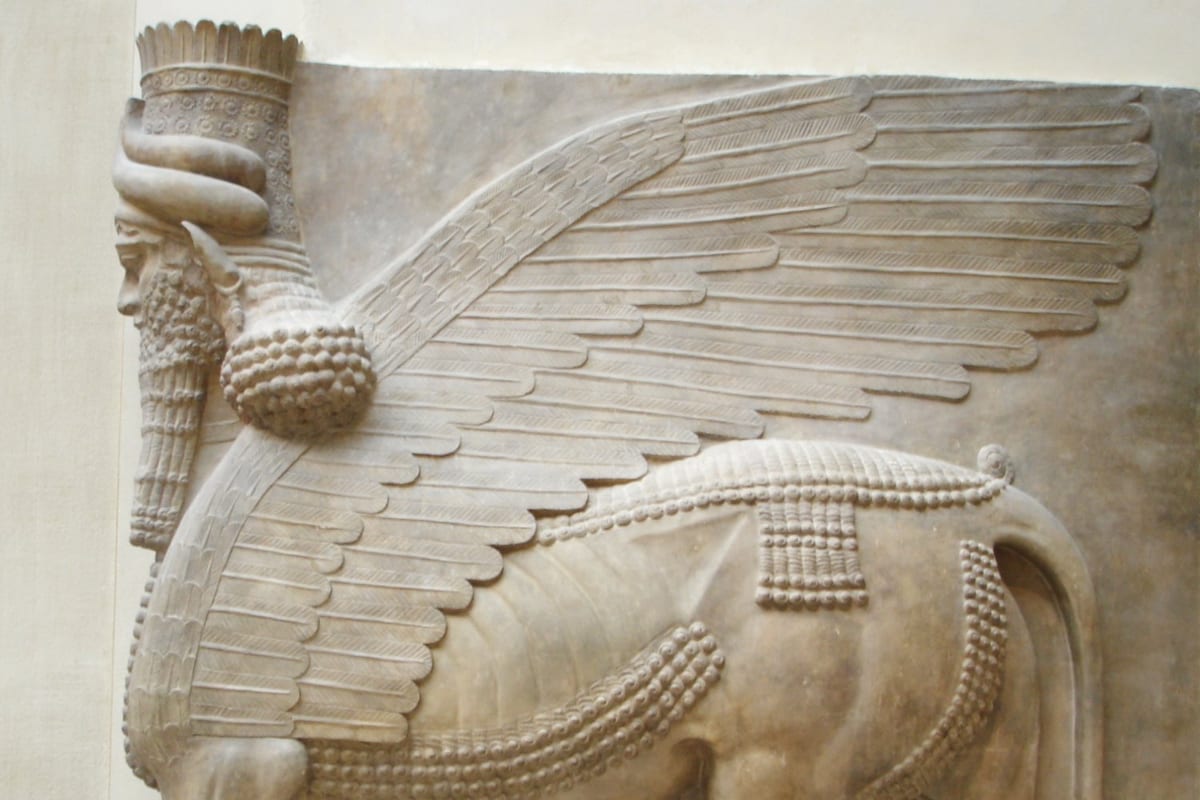
- British Museum, London — the largest Assyrian collection outside Iraq. Ashurbanipal’s lion-hunt reliefs, the Lachish siege reliefs, the Black Obelisk, colossal winged bulls (lamassu) from Nineveh and Nimrud
- Louvre, Paris — extensive Sargon II material from Khorsabad
- Metropolitan Museum of Art, New York — Nimrud reliefs
- Iraq Museum, Baghdad — statuary, reliefs and gold from Nimrud tombs (some looted in 2003, some recovered)
- Nineveh (Mosul) — much of the site was damaged by ISIS between 2014 and 2017, but restoration is ongoing; the winged bulls at the Nergal Gate have been partially reconstructed
- Nimrud — the walls were dynamited by ISIS in 2015; a major reconstruction project is underway with UNESCO support
- Hatra — a later Parthian-Assyrian caravan city, one of Iraq’s most striking ruins
See our Iraq travel guide.
Frequently asked questions
Where was the Assyrian Empire?
Who were the greatest Assyrian kings?
Why were the Assyrians so feared?
What was the library of Ashurbanipal?
How did the Assyrian Empire fall?
Can you visit Assyrian sites today?