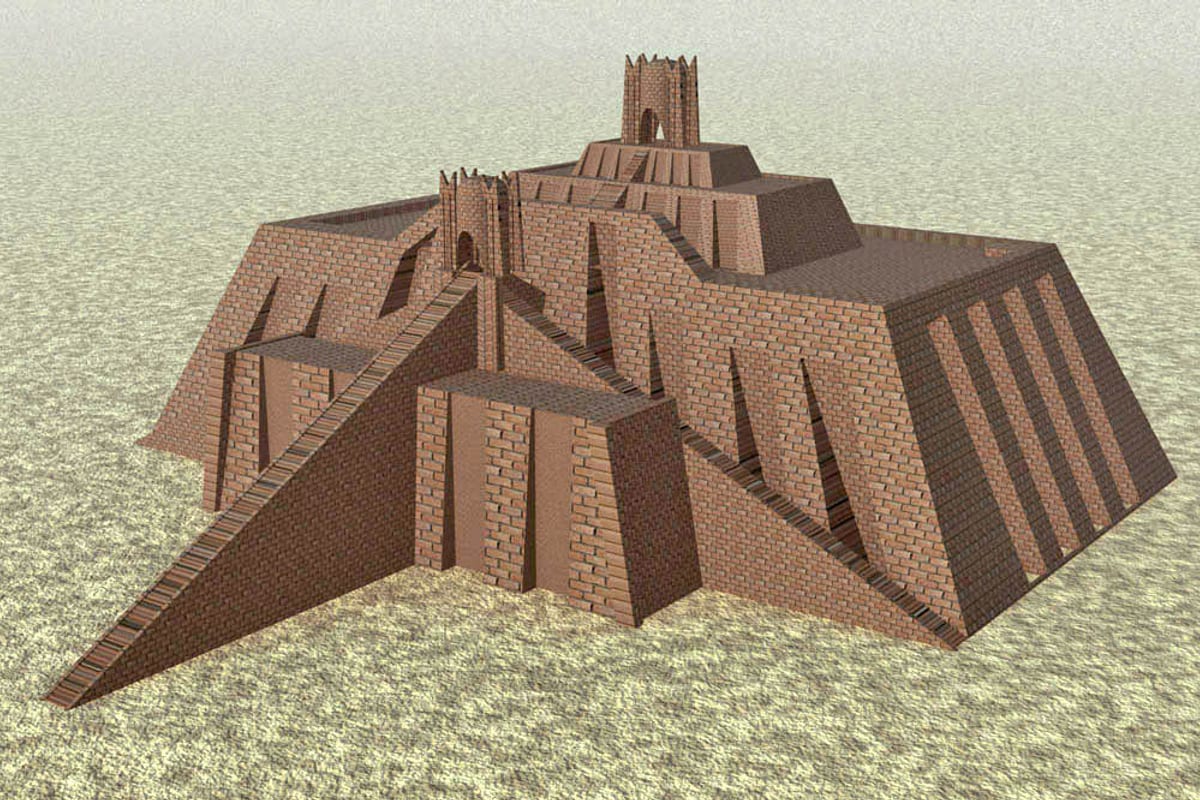
The ziggurat is the signature building type of ancient Mesopotamia — a tiered, terraced platform of packed brick with a small temple on top, sometimes 30 metres high and covering more than an acre. About two dozen ziggurats are known from Iraq. Around ten of them still have enough surviving structure to visit. This is a guide to the ones worth going to see.
For the wider Mesopotamian context see our Mesopotamia post. Iraq has stabilised significantly since 2018 and most of these sites are accessible again to guided small-group tourism. See our Iraq travel guide for logistics and current safety notes.
What a ziggurat actually is
The word comes from Akkadian ziqqurratum, meaning “raised”. Ziggurats were not tombs (unlike Egyptian pyramids) and not usually places of public worship. They were platforms — the physical foundation for a temple that sat on top, and the symbolic point where a city’s patron god descended to meet its priests.
Structurally they were solid packed mud brick throughout, with an outer facing of harder kiln-fired brick. The largest could reach seven tiers and weigh a million tonnes. Most have collapsed into shapeless mounds because mud brick, exposed to occasional rain over 3,000 years, eventually degrades to earth.
1. The Great Ziggurat of Ur (best-preserved)
The single most impressive ziggurat in Iraq, and the best place to understand what these buildings looked like. Built around 2100 BC by Ur-Nammu of the Third Dynasty of Ur, dedicated to the moon god Nanna. The base is 64 by 45 metres, originally three tiers rising to about 30 metres.
The lower stage was reconstructed in the 1980s under Saddam Hussein, using surviving fragments as a guide — accurately, by archaeological consensus. You can climb the modern staircase to the first terrace and see what a fresh ziggurat looked like from up top. The reconstruction stops there; the upper stages remain a mound.
Location: near Nasiriyah, southern Iraq. Access is easy on a day trip from Nasiriyah. Nearby you can also see the traditional site of Abraham’s house and the royal cemetery where Leonard Woolley’s 1920s excavations turned up spectacular gold jewellery (most of it now in the British Museum, some in Baghdad, some looted in 2003 and recovered since).
2. Uruk (Warka): the White Temple ziggurat
The world’s first city has some of the world’s oldest surviving ziggurats. The most striking is the White Temple platform, built around 3200 BC — over 5,000 years old. The original temple on top was faced with white gypsum plaster, hence the name.
Very little upper structure survives, but the layered brick platform is visible and the scale is impressive when you understand what you’re looking at. Uruk also has the Eanna precinct, a huge temple complex to the goddess Inanna, with several successive ziggurat-like platforms.
Location: near modern Warka, southern Iraq. About 90 minutes from Nasiriyah. Access is somewhat rougher than Ur — the site is spread across several kilometres and best visited with a guide.
3. Aqar Quf (Dur-Kurigalzu): dramatic silhouette
The tallest surviving ziggurat, though not the best-preserved. Built around 1400 BC by the Kassite king Kurigalzu I as the centrepiece of a new capital called Dur-Kurigalzu. The surviving core still stands 57 metres tall, mostly stripped of its outer facing brick.
The silhouette is one of the great images of ancient Iraq — a jagged brown finger of packed mud brick against the sky. Because so much of it is eroded, you can see the internal structure clearly: layers of reed matting bonding the mud-brick layers, drainage channels, foundation deposits.
Location: 30 km west of central Baghdad. Easy day trip, one of the closest ancient sites to the capital.
4. Nimrud (Kalhu): Assyrian ziggurat
The Assyrians built ziggurats too, though with local variations. Nimrud was Ashurnasirpal II’s capital in the 9th century BC, and its ziggurat was originally about 60 metres tall — a landmark for miles around. Nimrud was extensively damaged by ISIS in 2015-16; the ziggurat had already been badly eroded but the walls of the surrounding palaces were dynamited.
A restoration project is underway with UNESCO and Iraqi authorities. Access has resumed as of 2024. Location: 30 km southeast of Mosul.
5. Choga Zanbil (technically in Iran, but essential context)
Not in Iraq but just across the border in Khuzestan, Iran. The Elamite ziggurat at Choga Zanbil, built around 1250 BC, is the best-preserved ziggurat in the world — its outer face is essentially intact because the whole site was buried under sand within a generation of its completion and only re-excavated in 1935.
Every visitor to Iraqi Ur should also try to see Choga Zanbil if they can get an Iranian visa — the two together give you a complete picture of what these buildings originally looked like. UNESCO World Heritage since 1979. See our Iran travel guide.
6. Etemenanki (the Tower of Babel)
The most famous ziggurat of all, and the least visible. Etemenanki (see our Babylon post) once stood 90 metres tall in the centre of Babylon, in seven stages. Alexander the Great’s army dismantled the ruins in the 4th century BC to prepare for a rebuild that never happened, and the stones were carted off over the centuries.
What remains today is a marshy depression roughly the shape of the original base, ringed by low mounds of surviving foundation. It is essentially an outline in the ground. Included here because if you go to Babylon (and you should, it’s a day trip from Baghdad), the Etemenanki site is one of the things you will walk past.
Others worth mentioning
- Eridu — the oldest ziggurat platform, dating to around 3800 BC. Now a low, weathered mound but historically important as the birthplace of the type
- Nippur — ziggurat to Enlil, king of the Sumerian gods, once the most sacred site in Mesopotamia. The lower platform survives
- Larsa — ziggurat to the sun god Shamash, partially preserved
- Borsippa — near Babylon, the ziggurat of Ezida, dedicated to Nabu (god of writing). The upper stages collapsed and partially melted in an ancient fire, giving it a striking twisted silhouette
Practical visitor notes for Iraq (2026)
- Visa: most Western nationalities receive a visa on arrival at Baghdad International Airport ($75 USD)
- Getting around: internal flights are limited; most travel is by road with a licensed guide/driver. Small-group tours are the standard entry point
- Safety: southern Iraq (Baghdad, Nasiriyah, Basra) is safe for guided tourism. Central and western Iraq (Anbar, parts of Nineveh) still have security restrictions. Iraqi Kurdistan is separately administered and easy to visit independently
- When to go: October to April. Summer temperatures at the sites regularly hit 50°C
- Language: Arabic (Kurdish in the north); English is limited outside Baghdad tourist infrastructure. A guide is essentially required
Read our Iraq travel guide for current advisory notes and tour operator recommendations.
Frequently asked questions
What is a ziggurat?
How many ziggurats are there in Iraq?
What is the difference between a ziggurat and a pyramid?
Which ziggurat is the Tower of Babel?
Can you visit ziggurats in Iraq safely?
What is the best-preserved ziggurat in the world?