The Colosseum is the most recognisable ancient building in the world. About 12 million people visit it every year, more than any other archaeological site. Most of them have seen Ridley Scott’s Gladiator and expect two-handed swords, thumbs-down verdicts, and heroic single combats. The real Colosseum was different, weirder, and in some ways more brutal. Here is what actually went on.
For visitor logistics see our Italy travel guide.
The building
The Colosseum’s real name was the Flavian Amphitheatre (Amphitheatrum Flavium). It was commissioned by Emperor Vespasian around 72 AD as a gift to the Roman people, on the site of Nero’s enormous private lake in the middle of the Golden House complex. This was deliberate propaganda — Vespasian was recovering public land Nero had grabbed. His son Titus opened the building in 80 AD with 100 days of inaugural games. His younger son Domitian added the fourth-story attic and the hypogeum (underground service level) shortly after.
Dimensions:
- Long axis 189 m, short axis 156 m
- Outer wall originally 48 m high
- Arena floor 87 m × 55 m
- Capacity roughly 50,000-80,000 spectators (estimates vary; 50,000 is the standard figure)
The engineering is remarkable. Four superimposed orders of arches (Tuscan, Ionic, Corinthian, then Corinthian pilasters in the attic), 80 numbered entrances, ramps and stairs that could evacuate a full house in 15 minutes, retractable canvas awnings (velarium) rigged by an entire naval detachment based nearby specifically for this purpose. The Colosseum was a serious piece of infrastructure — not just a building but a machine.
The programme
A full day at the games typically ran:
- Morning: venationes — wild-animal hunts. Trained venatores (animal-hunter gladiators, a separate speciality) fought lions, leopards, bears, elephants, rhinos, giraffes, hippopotami. Vast numbers of animals were killed — Titus’s inaugural 100 days killed about 9,000 animals; Trajan’s 123-day victory games in 107 AD killed 11,000
- Midday: executions. Condemned criminals were killed in the arena, often in staged mythological scenarios — a criminal playing Orpheus torn apart by bears, or Icarus killed in a fall from a mechanical device. This is when most of the audience left for lunch. Some emperors (notably Claudius) preferred to stay and watch, and were considered morbid for it
- Afternoon: gladiators. The programme showpiece. Combats between paired gladiators of specific complementary types (see below)
Everything was hugely expensive. A moderately-sized set of games cost 60,000-100,000 sesterces (about 20-30 years’ pay for a legionary). Only the emperor and the wealthiest senators could stage them. The emperor’s games in particular were free to the public; entry was by numbered token distributed the day before, with seats allocated by social rank (senators in the front, then equestrians, then citizens, then women and slaves at the back).
Who the gladiators actually were
Most gladiators were prisoners of war, condemned criminals, or slaves. Some were free men who signed up voluntarily for the money — auctorati, who typically signed away their legal freedom for a fixed term in exchange for a signing bonus. Well-trained gladiators had genuine social status of a peculiar kind — they were legally infamous (their testimony was not valid in court) but they were also celebrities, whose portraits appeared on wine cups and whose names attracted graffiti. A few gladiators became rich enough to retire and set up their own training schools.
Life expectancy is disputed but was probably not as bad as popular imagination suggests. Gladiators represented a large investment (about 2 years of training, plus the purchase price). A dead gladiator was worth nothing to his owner (the lanista), so trainers had strong incentives to keep them alive. Analysis of skeletons from a gladiator cemetery at Ephesus suggests most gladiators died young but survived far more fights than modern movies imply — often 10-30 combats before death or retirement. Perhaps 1 in 10 combats ended in the loser’s death.
Female gladiators (gladiatrices) existed but were rare and controversial. Emperor Septimius Severus banned them in 200 AD.
Types of gladiator
Gladiators fought in matched pairs of different weapon types, deliberately unequal to make the combat interesting:
- Murmillo — heavy infantry with sword, large curved rectangular shield, gladiator-standard helmet with fish-shaped crest
- Thraex (Thracian) — small square shield, curved short sword, wide-brimmed helmet with griffin crest
- Retiarius — no armour, no helmet, trident, dagger, weighted net. The most distinctive type
- Secutor — the retiarius’s standard opponent. Heavy armour, sword, shield, smooth rounded helmet with just two small eye-holes (harder for a net to catch)
- Hoplomachus — Greek-style spear and small round shield, plus a short sword as backup
- Provocator — sword, shield, breastplate — the most heavily armoured type
- Bestiarius — trained specifically for wild-animal combat
Standard matchups were murmillo vs thraex, murmillo vs hoplomachus, retiarius vs secutor. These paired armoured swordsmen against differently-armed opponents to keep the action visually interesting and technically varied.
The thumbs down myth
When a gladiator was defeated, he could ask for mercy by raising his index finger (ad digitum). The crowd and the sponsor of the games would then decide his fate. The gesture used to grant mercy was probably pollice compresso — thumb pressed against fist, symbolising a sheathed weapon. The gesture used to condemn to death was probably pollice verso — thumb turned, though whether “turned up” or “turned down” is unclear from ancient sources. The modern thumbs-down is Jean-Léon Gérôme’s 1872 painting Pollice Verso, which invented the iconography that Hollywood has been repeating ever since.
Naumachiae: the flooded arena
The most spectacular Colosseum events were the naumachiae — mock naval battles staged inside a flooded arena. Cassius Dio mentions that Titus’s inaugural games in 80 AD included a naumachia. The Colosseum was designed with underground drainage that could theoretically flood and drain the arena floor, though the hypogeum system installed by Domitian a decade later probably made this impossible after 82 AD.
Full-scale naumachiae with hundreds of actual ships were staged at Rome by Caesar and Augustus in specially-dug basins on the Campus Martius and across the Tiber. Claudius staged one on Lake Fucinus involving 100 ships and 19,000 fighters — the largest single spectacle in Roman history.
The hypogeum
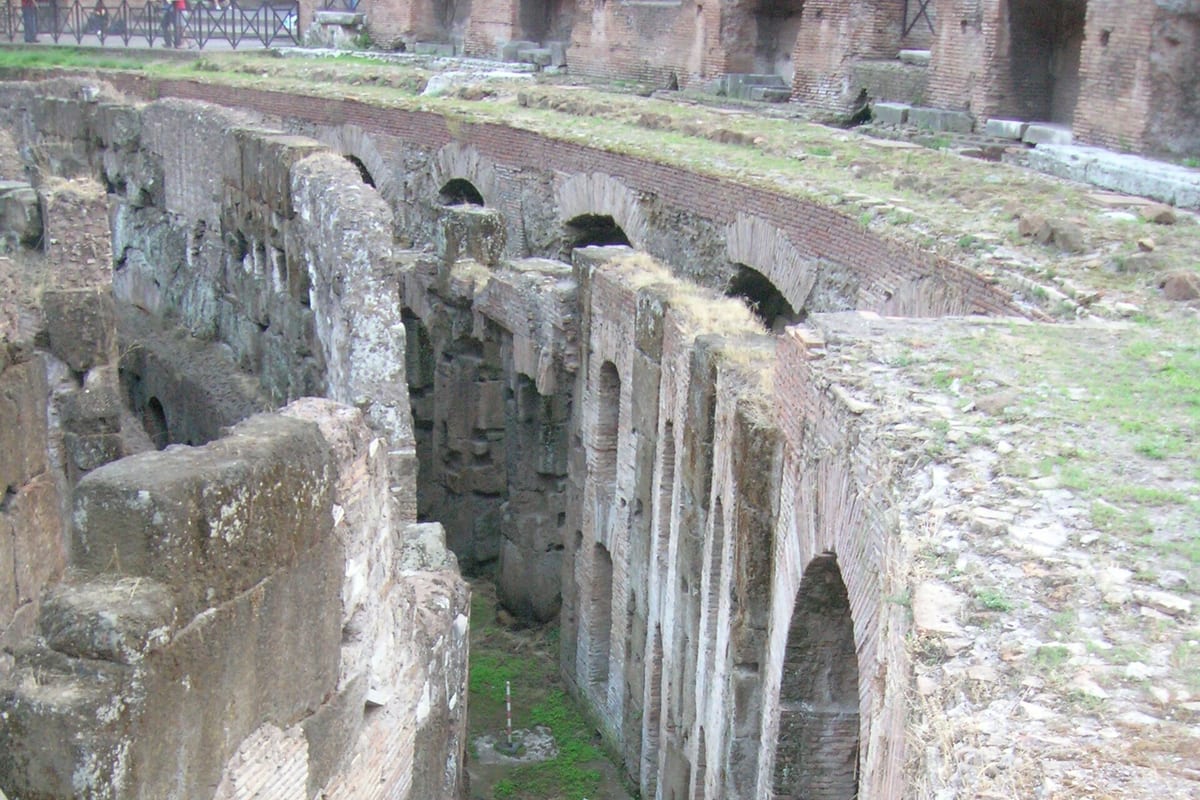
The hypogeum is the underground service level under the arena floor, built by Domitian around 82 AD. It contained holding cells for animals, gladiator preparation areas, storage for stage machinery, and 32 elevator shafts that could raise animals, gladiators, or scenery up to the arena floor through trap doors. Cranes moved sets in and out. It was essentially a Broadway backstage from 2,000 years ago, and it is what you look down into today when you visit the Colosseum — the wooden arena floor is long gone.
Selected areas of the hypogeum have been opened to guided tours as of 2021. A full arena floor reconstruction is planned to be complete in 2027-28, allowing visitors to walk on a replica of the original arena for the first time in centuries.
How and when it ended
Gladiatorial combat continued in Rome for about 350 years. Constantine banned it in 325 AD (Christian pressure), but the ban was widely ignored. Honorius issued a stronger ban in 404 AD after the Christian monk Telemachus was killed trying to stop a fight in the arena. The last documented gladiatorial games in Rome were held in 404 AD. Wild-animal hunts continued longer — the last documented venatio at the Colosseum was in 523 AD.
The building went through several later lives. It became a fortress (the Frangipane family fortified it in the 12th century), then a source of building stone (much of St Peter’s Basilica and the Palazzo Venezia are Colosseum marble), then a religious site (Pope Benedict XIV consecrated it as a memorial to Christian martyrs in 1749, though the historical evidence for extensive Christian martyrdoms there is thin), and finally the archaeological monument we visit today.
Visiting practicalities
- Ticket: the standard ticket (€18 in 2026) covers the Colosseum plus the Roman Forum and Palatine hill, valid for 24 hours. Buy online in advance; walk-up queues are horrible
- Timed entry: entry is timed and slots do sell out weeks ahead in peak season. Book at least 2-3 weeks ahead for spring or autumn, longer for high summer
- Hypogeum and arena floor tour: separate additional ticket (about €24) with a guide, well worth the extra cost. Must be booked ahead — often the last availability to sell out
- Best time: first entry slot of the morning (usually 8:30-9am) or last two hours before closing. Avoid 11am-3pm in summer
- Time needed: 90 minutes to 2 hours for the Colosseum itself, another 3-4 hours for the Forum and Palatine
- Skip-the-line-with-guide tours: worth considering if you have limited time and want context, but the audio guide covers the same material more cheaply
See our Italy travel guide and pair with our Pompeii post for a proper Roman deep-dive week.
Frequently asked questions
When was the Colosseum built?
How big was the Colosseum?
Who were the gladiators?
How often did gladiators die?
What is the thumbs-down myth?
How do I visit the Colosseum?