For 500 years the Roman legions were the most effective military force in the ancient world. They faced Celtic longsword warriors, Greek hoplite phalanxes, Persian cavalry archers, Germanic tribal armies, Parthian cataphracts, and elephant-riding kings — and beat most of them, most of the time. Their advantage was not superior weapons or numbers. It was organisation, drill, engineering, and administration.
Here is how the Roman army actually worked. See our Rome history and our Julius Caesar post for the military context.
The organisation
The imperial-era legion was a professional infantry unit of about 5,400 fighting men. Its structure was standardised across all 28 legions (later 33) of the empire:
- Contubernium — 8 men who shared a tent and cooked together
- Century — 80 men (officially 100 originally, later fixed at 80), commanded by a centurion
- Cohort — 480 men (6 centuries), commanded by the senior centurion
- Legion — 4,800 heavy infantry in 10 cohorts (the first cohort was double-strength), plus 120 cavalry, plus artillery, plus engineers, plus a full support train
Each legion was commanded by a legatus legionis — a Roman senator on a military tour, typically around 30 years old. Under him were six tribuni militum (young officers, one of them a senator on his first tour, the other five equestrians). The real professional backbone was the centurions — up to 60 per legion, promoted from the ranks, average 20+ years of service each.
Auxiliary units attached to each legion doubled its total size. Auxiliaries were non-citizens (usually recruited from just-conquered territories) serving 25-year terms in exchange for eventual Roman citizenship for themselves and their families. They provided specialised cavalry (Gaulish and Germanic horsemen), archers (Cretans, Syrians), slingers (Balearics), light infantry, boatmen. In practice most Roman field armies were roughly half legionaries and half auxiliaries.
Equipment
A 1st-century AD legionary carried:
- Lorica segmentata — the distinctive articulated plate armour of about 9 kg. Earlier and later legions wore chain mail (lorica hamata) or scale (lorica squamata) instead
- Galea — an iron or bronze helmet with cheek pieces and a neck guard
- Scutum — a large curved rectangular shield of laminated wood covered in leather and canvas, with an iron boss in the centre. About 10 kg. Curved to protect the sides as well as the front
- Gladius — a short double-edged thrusting sword about 60cm long, worn on the right hip. Ideal for close-quarters stabbing behind a shield
- Pilum — a heavy throwing spear, two per legionary. The design was clever — a narrow iron shank that bent on impact so it could not be thrown back and got stuck in enemy shields, forcing them to be dropped
- Pugio — a broad-bladed dagger, backup weapon
- Marching pack — cooking pot, personal effects, three days’ rations, entrenching tools. Total marching load was about 30-45 kg
Standard tactics
Roman battle drill was simple in principle:
- Approach the enemy in a controlled march to a set distance
- Throw pila at 15-30 metres — enough to break up an enemy formation without giving them time to recover
- Draw swords and charge into contact
- Fight in a tight formation where the front rank engages while the second rank stabs past shields to support
- Rotate ranks every few minutes — the front rank stepped back through gaps to rest while a fresh rank came forward
The critical difference from Greek or Celtic opponents was that Roman soldiers could rotate ranks in the middle of a fight. Most ancient armies fought as static blocks; once the front row got tired, they got killed. Roman legions kept fresh men in contact indefinitely, which meant they wore opponents down.
The drill was constant. Vegetius (a Roman military writer of the 4th century AD) records that recruits were drilled at swordwork against man-sized wooden posts twice a day, drilled at throwing pila into targets, marched in full kit 30 km in five hours (the “military step”), and swam and ran under supervision. A Roman legion could execute complex battlefield manoeuvres — wheel, extend, retreat by ranks, form a wedge — that most ancient armies could not manage.
Engineering
Every legionary was also a construction worker. At the end of each day’s march on campaign, the entire legion built a fortified camp — a rectangular enclosure with an earth-and-timber palisade, ditch, four gates, and standardised internal layout. This took a couple of hours because the legion drilled at it constantly, everyone knew exactly what to do, and every camp had the same layout.
The result: a Roman army on campaign never slept in the open. It slept behind fortifications, every night. This eliminated night attacks as a strategy against Romans. It also meant Romans could stop and dig in almost anywhere.
Legions also built the roads and bridges they marched on. The 400,000 km of Roman paved road across the empire were mostly built by soldiers in between wars. Same for aqueducts, siege works and permanent fortresses.
Siege warfare was where Roman engineering really showed. Caesar at Alesia in 52 BC built 25 km of double siege lines (inner facing Vercingetorix’s trapped force, outer facing the relief army) in a matter of weeks. Titus at Jerusalem in 70 AD built a wall around the whole city, then systematic assault ramps against the walls. Both operations would have been impossible for any non-Roman army.
Discipline
Roman military discipline was harsh. Sleeping on guard duty was a capital offence — executed by beating to death with clubs by fellow soldiers. Cowardice or mutiny by a whole unit could be punished with decimation: one man in ten, chosen by lot, executed by the other nine. This was rare (the last documented use was under Crassus in 71 BC) but existed as a threat.
On the other side, rewards were extensive. Individual bravery earned decorations — coronae (crowns for specific feats — first over an enemy wall, saving a comrade’s life, etc.), armlets (armillae), medallions (phalerae). Successful campaigns produced land grants and cash bonuses (donativa) on discharge.
Pay and retirement
A 1st-century AD legionary earned 225 denarii a year, about the same as a moderately-skilled labourer. Deductions for equipment, food, and clothing brought take-home to about 75 denarii — modest but reliable, and paid in cash three times a year. Centurions earned much more (probably 15-20x a legionary’s pay).
Service was 25 years. On discharge, legionaries received either a cash bonus (from Augustus onwards, 3,000 denarii — about 13 years’ pay) or a plot of land in a veteran colony. The colonies were founded specifically to settle discharged veterans; hundreds of modern cities across Europe started this way — Cologne (Colonia Agrippinensis), Colchester (Camulodunum), Merida (Emerita Augusta), Beirut (Colonia Berytus).
Auxiliary cavalry
Legions were not really cavalry armies — the 120 legionary cavalrymen were essentially scouts and messengers. Serious mounted work was done by auxiliary units, which by the 2nd century AD included heavy armoured cavalry (cataphractarii), horse archers (Palmyrene, later Sarmatian), and standard medium cavalry (Batavian, Thracian, Gaulish). At full strength the empire had perhaps 200,000 cavalry, similar to the total legionary strength.
The decline
The classic legion peaked in the 1st and 2nd centuries AD. By the late empire (from about 250 AD onwards) the standard organisation was breaking down. Legions were split into smaller mobile field forces (comitatenses) and static frontier garrisons (limitanei), infantry armour decreased, cavalry increased, and recruitment was increasingly of Germanic contingents who had never served under classical Roman conditions.
By the 5th century AD the Western Roman army was almost entirely Germanic in composition, and its collapse into private warbands was one of the mechanisms of the fall of the West.
Where to see the Roman army today
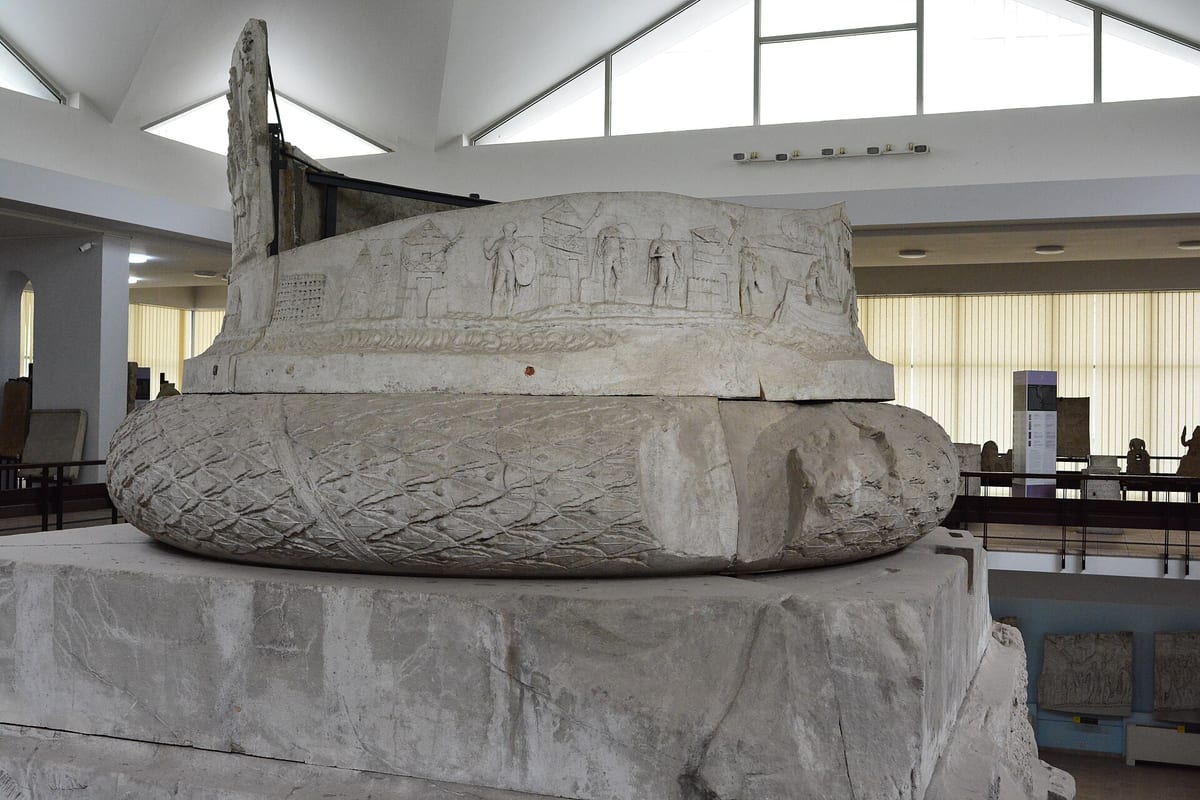
- Trajan’s Column, Rome — 155 scenes carved in stone showing the Roman army in campaign, from crossing the Danube to storming Dacian forts. The best single visual source for how Roman soldiers looked and worked
- Hadrian’s Wall, England — 117 km of Roman frontier fortification with dozens of forts, mile-castles and turrets. Vindolanda museum has the most extraordinary preserved organic material (wooden writing tablets from ordinary soldiers)
- Alesia, France — reconstructions of Caesar’s siege works from 52 BC
- Masada, Israel — Titus’s siege ramp still visible, one of the best-preserved Roman siege operations
- Rome’s military museums — the Museo della Civiltà Romana at EUR
- Xanten Archaeological Park, Germany — reconstructed Roman fort and civilian city
- Deva Victrix (Chester), England — one of the best-preserved legionary fortresses in Britain
See our Italy, France, UK and Germany travel guides for planning.
Frequently asked questions
How big was a Roman legion?
What weapons did Roman soldiers use?
How did Roman soldiers fight?
How long did Roman soldiers serve?
How were Roman legions so effective?
Where can you see Roman military sites?