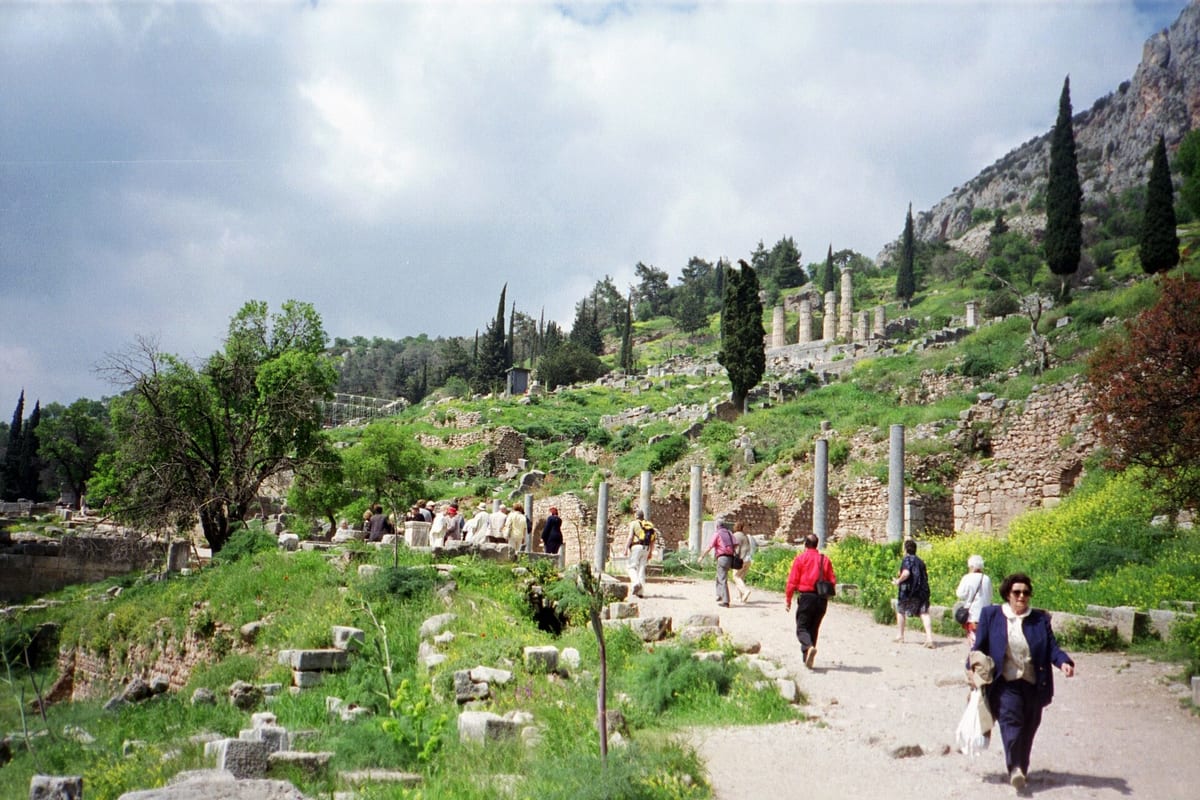
For a thousand years, from at least the 8th century BC to the 4th century AD, the Oracle of Delphi was consulted by every major state in the Greek and Roman world before any significant decision. Colonies were founded on its advice. Wars were begun (and sometimes averted) on its predictions. Rome dispatched official embassies to it. The sanctuary sits on a mountainside in central Greece and can still be visited — one of the most atmospheric ancient sites anywhere.
Here is how the Oracle actually worked, what it really said, and how to visit today. See our Greece travel guide.
Where and why
Delphi sits on the southern slope of Mount Parnassus in central Greece, about 180 km northwest of Athens. The setting is genuinely spectacular — the sanctuary is stacked up a steep hillside overlooking a valley that runs down to the Corinthian Gulf. It rains too much, freezes in winter, and can be shrouded in cloud for days on end. The Greeks considered this the omphalos — the navel of the world.
The site was already sacred in Mycenaean times (there are Bronze Age offerings under the classical layers). Greek myth explained the sanctity through a story about Apollo killing a giant serpent (Python) that lived there — his priestess is still called the Pythia in memory of the serpent.
How the Oracle worked
Delphi’s Oracle operated for one week a month, nine months of the year (closed in winter, when Apollo was said to leave and Dionysus took over the sanctuary). Consultation followed a strict ritual:
- Purification — the questioner washed at the Castalian Spring, still bubbling out at the base of the cliff
- Payment — a fee (the pelanos) plus a preliminary sacrifice. Wealthy cities paid huge sums; the Athenian treasury built on the sacred way is what a serious client donation looked like
- Queue — questioners drew lots for order of consultation. Certain cities (like Sparta) held permanent priority
- The question — the Pythia (chief priestess of Apollo, always an older woman from the local area) sat on a tripod stool in the inner chamber (adyton) of the Temple of Apollo. Priests conveyed the question. The Pythia responded, sometimes in verse, sometimes in prose
- Interpretation — priests wrote down or paraphrased the response for the questioner
Ancient sources describe the Pythia going into a trance, sometimes muttering incoherently, with her utterances rendered into verse by attending priests. What caused the trance has been the subject of two millennia of speculation.
The ethylene hypothesis
In 2001, a team of American researchers led by geologist Jelle de Boer proposed that the trance was caused by ethylene gas seeping through geological faults under the temple. Ethylene (used in mid-20th-century medicine as an anaesthetic) causes exactly the symptoms ancient sources describe — mild euphoria, disembodied speech, occasionally violent convulsions if the dose is too high.
The researchers found faults in the bedrock under the temple and detected ethylene traces in the modern spring water. The evidence is not conclusive — ethylene levels today are too low to induce trance, but they could have been higher in antiquity when tectonic conditions were different.
Whatever the mechanism, we can be confident that the Pythia’s ecstatic state was real and was probably some form of altered consciousness, not simply performance. Ancient writers who visited (Plutarch was actually a priest at Delphi for many years) describe the phenomenon in convincing detail.
Famous predictions
The Oracle’s reputation was built on a series of famous responses:
- Croesus of Lydia (546 BC) — asked whether he should attack Persia. Received the answer: “if you cross the Halys river, you will destroy a great empire.” He did, and he did — his own. The Oracle’s reputation for double-edged answers dates from this.
- Athens (480 BC) — asked what to do about the approaching Persian invasion. Received a first oracle predicting doom, then a second telling them to trust “wooden walls”. Themistocles interpreted this as the Athenian fleet, evacuated the city, and won the Battle of Salamis.
- Sparta (fifth century BC) — routinely consulted before military campaigns, often received cautious counsel that discouraged particular wars.
- Nero (67 AD) — visited Delphi, received a warning to “beware the seventy-third year”. Interpreting this as a prediction of long life, he ordered the death of the general Galba (age 71). Galba got to Nero first, at Nero’s age 30, in 68 AD.
The pattern is real: many oracles were ambiguous enough that they were arguably right whichever way events turned. This is not necessarily fraud — it may simply be that priests, given local intelligence about the questioner’s situation and reasonable estimates of likely outcomes, produced advice that hedged its bets.
What Delphi paid for
Grateful clients funded the sanctuary’s buildings. The Sacred Way winding up the hill is lined with the ruins of “treasuries” — small temple-like buildings put up by individual cities to display their offerings. The Athenian Treasury, built around 490 BC to commemorate the victory at Marathon, has been partially reconstructed and is easily the most photogenic of them.
Other structures on the sacred way include the Sphinx of the Naxians (a colossal marble statue on a column), the Serpent Column commemorating the Greek victory at Plataea (moved to Constantinople by Constantine in 324 AD and still standing in Istanbul’s hippodrome), the Charioteer of Delphi (one of the finest surviving classical bronze statues, now in the museum), and the Stoa of the Athenians (holding trophies from Persian War naval victories).
The Temple of Apollo
The main temple was rebuilt several times — the classical version we see today was completed around 330 BC, replacing an earlier version that had burned down in 548 BC. Six columns still stand at the northeast corner; the rest are foundations. Behind the temple, up the slope, are the theatre (5,000 seats, still used for occasional performances) and, higher again, the stadium where the Pythian Games — a religious festival second only to the Olympics — were held every four years.
The Tholos of Athena
The postcard shot of Delphi is not from the main sanctuary but from a smaller sanctuary called the Marmaria a few hundred metres further along the road. The Tholos there — a circular temple with three restored columns — is one of the most beautiful surviving Classical buildings and probably the most photographed thing on the site.
The end
Delphi kept operating through the Roman Empire, but attendance dropped steadily after the 2nd century AD as Christianity spread. The Roman emperor Julian (the Apostate) sent a delegation in 362 AD asking for advice on reviving pagan worship. The Oracle’s reported answer: “Tell the emperor the beautifully wrought house has fallen; Apollo no longer has a house nor a laurel-branch nor a prophetic spring — even the babbling water has run dry.” Delphi effectively closed itself. Theodosius formally banned pagan worship in 391 AD.
The site was abandoned and gradually buried under an agricultural village called Kastri, until the villagers were relocated in 1892 to allow French archaeologists to begin systematic excavation. Delphi has been a UNESCO World Heritage Site since 1987.
Visiting today
- Getting there: 2.5 hours by car or bus from Athens. Direct KTEL buses several times daily from Athens’s Liosion bus terminal
- Stay: the modern village of Delphi (a short walk from the ruins) has plenty of small hotels with dramatic valley views
- Sequence: main sanctuary first (allow 2 hours), then the museum (allow another 1-2 hours), then the Marmaria and Tholos, then the Castalian Spring
- Museum highlights: the Charioteer of Delphi (one of very few surviving classical bronzes), the Sphinx of the Naxians, the Twins of Argos, the frieze of the Siphnian Treasury
- Timing: April-May and September-October ideal. Winter can be beautifully atmospheric but the site is exposed and often wet
See our best time to visit Greece and pair with Meteora (2 hours further north) for a stunning central Greece 3-day trip.
Frequently asked questions
What is the Oracle of Delphi?
How did the Oracle actually work?
What caused the Pythia’s trance?
What is the most famous oracle in history?
Why did the Oracle of Delphi end?
Can you visit Delphi today?