Persepolis is the ancient world’s most under-visited great ruin. It sits an hour outside Shiraz in southern Iran, gets a fraction of the crowds that overwhelm the Acropolis or Pompeii, and holds the single greatest surviving image of the Persian Empire: the Apadana staircase, carved with representatives of 23 subject peoples bringing tribute to the king.
This is a structure-by-structure walking tour of the site, in the order you’ll want to see them. For the wider history see our Persian Empire post. For logistics see our Iran travel guide.
What Persepolis actually was
Persepolis was not the working capital of the empire — that was Susa. It was a ceremonial complex, purpose-built to host the annual Nowruz (New Year) celebration in late March, when representatives of every subject nation arrived to pay tribute to the king. It was probably occupied full-time only for a few months a year.
Construction began under Darius I around 518 BC and continued under his son Xerxes and grandson Artaxerxes for the next 150 years. The Palace of Darius, the Apadana and the Gate of All Nations are Darius’s work; the Hall of a Hundred Columns is Xerxes’s.
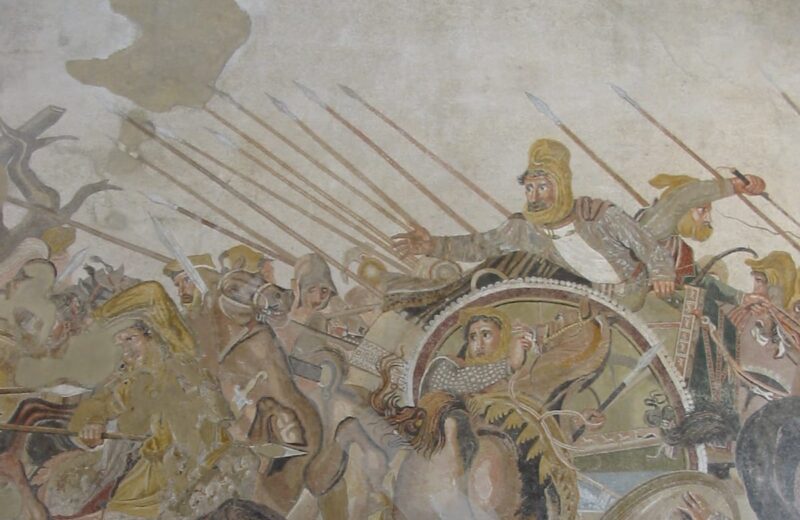
Alexander the Great burned Persepolis in 330 BC, either in a drunken party at the urging of an Athenian courtesan (Plutarch’s version) or as a deliberate act of revenge for Xerxes’ burning of Athens 150 years earlier (Arrian’s version). Modern archaeology suggests deliberate — the burning was systematic and the loot had already been carried off.
The Great Staircase (start here)
The site sits on a massive stone terrace, roughly 125,000 square metres, cut into the flank of the Mount of Mercy. You enter by climbing the Great Staircase — 111 shallow steps at a gradient designed so horses could climb them without difficulty. The steps are wide enough for two horsemen to ride abreast. The stone treads still show polish from 2,500 years of feet.
The staircase opens onto the Gate of All Nations (Gate of Xerxes), where visitors were greeted by two colossal winged bulls with human faces (lamassu) inspired by earlier Assyrian versions. One is still standing; the other is a partial reconstruction. On the inner face of the gate, an inscription in three languages — Old Persian, Elamite and Babylonian — announces that Xerxes built the gate.
The Apadana
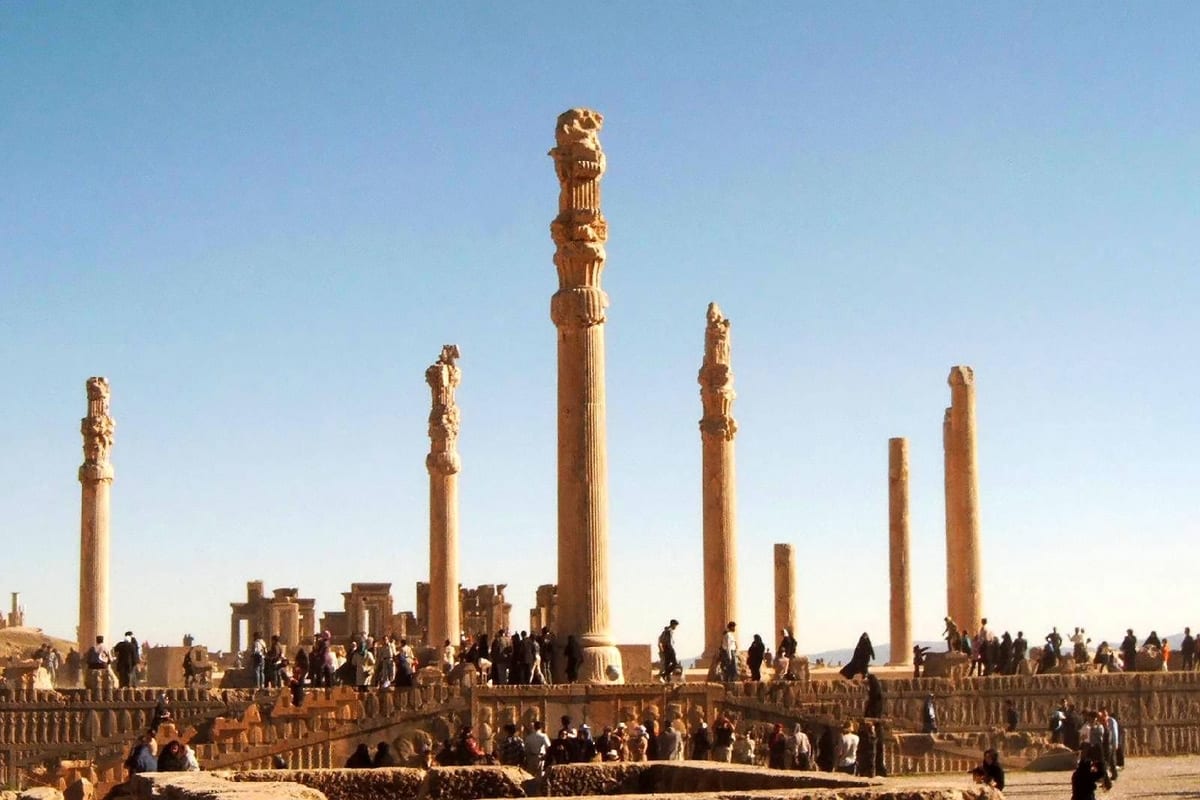
The Apadana is the heart of Persepolis and the reason to come. It was Darius’s great audience hall — a square building 60 metres to a side, roofed by 72 columns each 20 metres tall (13 still stand). The king sat on his throne here to receive Nowruz tribute.
The Apadana’s two great staircases (north and east) are carved with the finest reliefs in the empire. Twenty-three delegations from Persia’s subject nations are shown, each led by a Persian noble, bearing gifts appropriate to their homeland: Medes with horses, Ethiopians with elephant tusks, Babylonians with textiles, Bactrians with camels, Indians with donkeys, Ionian Greeks with fabric, Egyptians with a bull. Every relief is different. It is the world’s best visual record of the ethnic composition of the ancient world outside Egypt.
The reliefs survived because they were quickly buried under debris after Alexander burned the roof. When they were uncovered by archaeologists in the 1930s, the crisp carving was preserved as if fresh. Only around 25% of the palace has been excavated; more still lies buried.
The Palace of Darius (Tachara)
Immediately south of the Apadana sits Darius’s smaller private palace — the Tachara. It was completed by his son Xerxes, who also added an inscription praising his father. This is the best-preserved individual palace on the terrace; several door-frames still show scenes of Darius (or an anonymous king representing Darius) fighting mythical beasts. Old graffiti carved by 19th-century European travellers can be spotted around the doorways — the Persepolis version of “Kilroy was here”.
The Hall of a Hundred Columns (Throne Hall)
Larger than the Apadana in floor area, this hall was built by Xerxes and Artaxerxes as an official audience chamber for imperial dignitaries. It once had — as the name suggests — 100 columns, each 14 metres tall, arranged in a grid. None of them stands today. The hall was heavily damaged by Alexander’s fire.
The doorways survive and are carved with royal scenes. The east doorway shows the king enthroned, supported by figures representing all the subject peoples.
The Palace of Xerxes (Hadish)
Xerxes’s private residence, south of the Apadana. Fire damage is more visible here; you can see burn marks on the surviving door jambs. The palace is thought to have burned first because Alexander’s troops targeted the residence of the king who burned Athens.
The Treasury
In the far south-east corner sits the imperial treasury — where Alexander’s troops found and looted the accumulated wealth of two centuries of empire. 3,000 pack animals were reportedly needed to carry it away. What survived intact was the archive of clay tablets recording payments to the workers who built and maintained Persepolis — thousands of them, now our best source for the daily economy of the empire. Most are held at the Oriental Institute in Chicago.
Naqsh-e Rustam (add this on)
Six kilometres north of Persepolis, four Achaemenid royal tombs are cut into a cliff face — Darius I, Xerxes I, Artaxerxes I and Darius II. Each tomb has a cross-shaped facade with the king shown standing on a throne borne by representatives of the subject nations, the same imagery as the Apadana reliefs. The reliefs are 20 metres above ground level, which is one reason they have survived so well.
The site also has spectacular later Sasanian reliefs (3rd century AD) showing Persian kings defeating Roman emperors — including one of the Roman emperor Valerian kneeling before Shapur I.
Visiting today
- How to get there: 1 hour from Shiraz by taxi or organised tour. Most visitors do Persepolis, Naqsh-e Rustam and Pasargadae as a single long day-trip.
- Timing: October to April. Summer temperatures can be brutal — the site has almost no shade.
- Time needed: 3-4 hours for Persepolis itself, another 90 minutes for Naqsh-e Rustam.
- Guide: strongly recommended. The reliefs are much richer if you understand what you’re looking at.
- Entry fee: around 500,000 Iranian rials (about $10 USD at 2026 rates) for foreigners.
- Photography: allowed everywhere; no tripods.
Pair with our Iran travel guide and best time to travel by country.
Frequently asked questions
Where is Persepolis?
When was Persepolis built?
Why did Alexander burn Persepolis?
What can you see at Persepolis today?
How long do you need at Persepolis?
Is Persepolis safe to visit?