Western philosophy was mostly invented in Athens between about 470 and 322 BC — a 150-year window in a single city. Socrates was executed in 399 BC. Plato founded the Academy around 387 BC and taught there for 40 years. Aristotle founded the Lyceum in 335 BC. All three sites are still walkable, and all three sit within a few kilometres of the Acropolis.
Here is the traveler’s guide, with the historical context to make each site actually mean something. See our Athens under Pericles post for the wider historical context.
The Athenian Agora: Socrates’s office
Socrates did not have an academy. He did not write books. His method was to walk into the Agora — the central marketplace of Athens — pick out anyone who claimed to know something (a general on courage, a priest on piety, a poet on virtue), and ask questions until the person contradicted himself. Xenophon and Plato both describe him doing this daily for about 30 years.
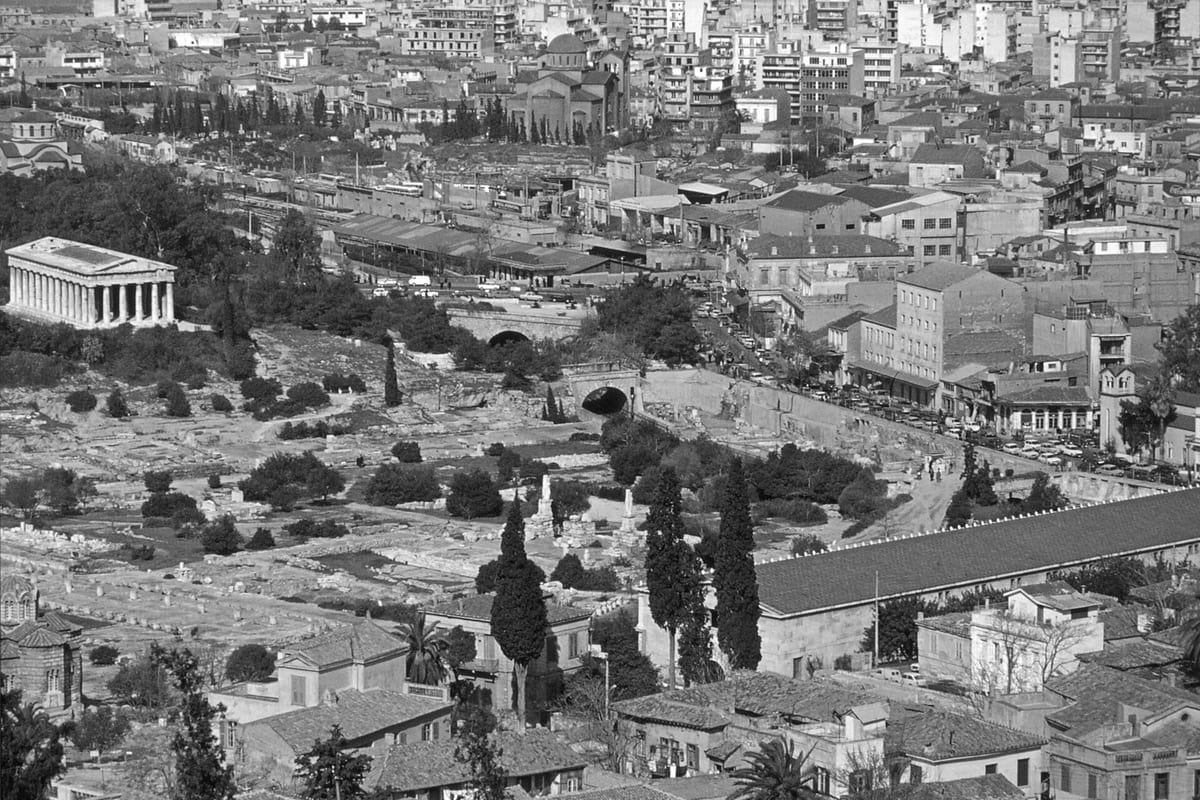
The Agora is still there, at the foot of the north slope of the Acropolis. You can walk in through the same gate Socrates used. The Ancient Agora of Athens is one of the best-preserved Classical Greek civic spaces, with the Temple of Hephaestus (the best-preserved Doric temple anywhere) still standing on its western edge.
Specific spots to find:
- The Stoa of Attalos — a full-scale 1950s reconstruction by American archaeologists, giving you a good sense of what a Greek stoa (covered walkway) actually looked like
- The Stoa of Zeus Eleutherios (foundation only) — one of Socrates’s regular meeting places, mentioned repeatedly in Plato’s dialogues
- The State Prison (small ruined building southwest of the Agora) — where Socrates was probably executed in 399 BC
- The Bouleuterion — meeting place of the Council of 500, where Socrates served briefly
- Museum inside the Stoa of Attalos — includes an ostrakon (pottery shard used in ostracism votes) with Themistocles’s name on it, plus other artefacts from Socrates’s time
The Areopagus and the trial of Socrates
Socrates was tried in 399 BC for “impiety” and “corrupting the youth” — really, for being a politically inconvenient critic. His trial took place before a jury of 500 Athenian citizens, probably in a court on the Agora. He was convicted by a narrow majority, refused to escape (though friends bribed the guards), and drank hemlock in the state prison.
The Areopagus (a rocky outcrop just below the Acropolis, easy walk from the Agora) was where Athens’s ancient supreme court met. It is also famously the site where the Apostle Paul preached in 51 AD (Acts 17), telling the Athenians about “the unknown god” whose altar he had spotted in the city. Both events are commemorated with plaques on the summit today. The view over the Agora and Acropolis is worth the climb.
Plato’s Academy
Plato was Socrates’s greatest student. After Socrates’s execution he travelled abroad for a decade, then returned to Athens and around 387 BC founded a school in a wooded grove outside the city walls sacred to the hero Academus — hence “Academy”. Plato taught there for the next 40 years. The Academy continued to operate, off and on, until Emperor Justinian closed it in 529 AD — a 900-year lifespan that no modern university has yet matched.
The site is about 2 km northwest of the ancient city walls, in what is now the working-class Athens neighbourhood of Akadimia Platonos. It is a modest public park with visible foundation walls, a small museum, and almost no tourists. The atmosphere is not thrilling — mostly it looks like an untidy garden — but standing on the ground where the Republic was probably taught for the first time is genuinely affecting.
Getting there: about 30 minutes’ walk from Monastiraki, or a short bus/metro ride. Best combined with the National Archaeological Museum.
Aristotle’s Lyceum
Aristotle studied at Plato’s Academy for 20 years, then travelled and tutored the young Alexander the Great in Macedon. He returned to Athens in 335 BC and founded his own school in another wooded grove east of the Acropolis, sacred to Apollo Lyceios — the Lyceum.
Aristotle’s teaching style was different from Plato’s. He walked with his students in the covered colonnades (peripatoi) — hence his followers were called the Peripatetics, “the walkers”. The Lyceum ran until Sulla sacked Athens in 86 BC.
The site was rediscovered in 1996 during construction for the Athens Museum of Modern Art. It sits between Rigillis and Vasileos Konstantinou streets, a 15-minute walk east of Syntagma Square, with the modern city looming around it. Free to enter, with excavated foundations of the palaestra (wrestling area) and stoas where Aristotle taught. Again modest, again historically remarkable.
The Pnyx and public philosophy
Not all Greek philosophy was academic. The Pnyx hill, west of the Acropolis, was where the Athenian Assembly met — where about 6,000 male citizens gathered 40 times a year to debate and vote on state policy. This is where political philosophy stopped being theoretical. Every Athenian politician who ever spoke on the Pnyx was practising the rhetoric Plato and Aristotle would later analyse.
The rostrum (bema) from which Pericles gave his famous funeral oration in 431 BC is still identifiable — a stepped stone platform cut into the rock. The whole Pnyx is a free public park, quiet and rarely visited, with views over the Acropolis.
The Stoa Poikile: where Stoicism was born
Zeno of Citium came to Athens from Cyprus around 313 BC and started teaching at the Stoa Poikile (“Painted Stoa”) on the north side of the Agora — a covered colonnade decorated with famous battle paintings. His followers were nicknamed “the Stoa people” — Stoics. The philosophy went on to become the most influential in the Roman world (Seneca, Epictetus, Marcus Aurelius were all Stoics).
The foundation of the Stoa Poikile was excavated between 1981 and 2007. It sits at the northern end of the Agora archaeological zone; you can walk right past it. The upper structure is long gone.
Practical walking tour (half a day)
All the essential sites are within a compact walking radius. A reasonable order:
- Start at the Ancient Agora — enter from Adrianou street, spend 90 minutes including the Stoa Museum
- Visit the Areopagus — short climb, 15 minutes for the view
- Walk the Pnyx — quiet paths, another 30 minutes
- Walk to the Lyceum site — 20-minute walk via Syntagma Square
- Bus or long walk to Plato’s Academy — 40 minutes total
Total: about 5-6 hours including breaks. Best done outside July-August heat. See our Greece travel guide and best time to visit Greece.
Frequently asked questions
Where did Socrates teach?
Where is Plato’s Academy?
Can you still visit Aristotle’s Lyceum?
Where was Socrates executed?
How long did Plato’s Academy last?
Are the Greek philosophy sites worth visiting?