Almost everything most people know about Sparta comes from the film 300, which is loosely based on a graphic novel, which is loosely based on Herodotus, who was hostile to Sparta. The real ancient Sparta was stranger than any of them, and in some ways more disturbing. It was also small — at its 5th-century BC peak, Sparta had maybe 8,000-10,000 full citizens plus their families, propped up by an underclass of about 200,000 Greek slaves called helots who did almost all the actual work.
Here is the honest history. For context see our history of ancient Greece.
Where and when
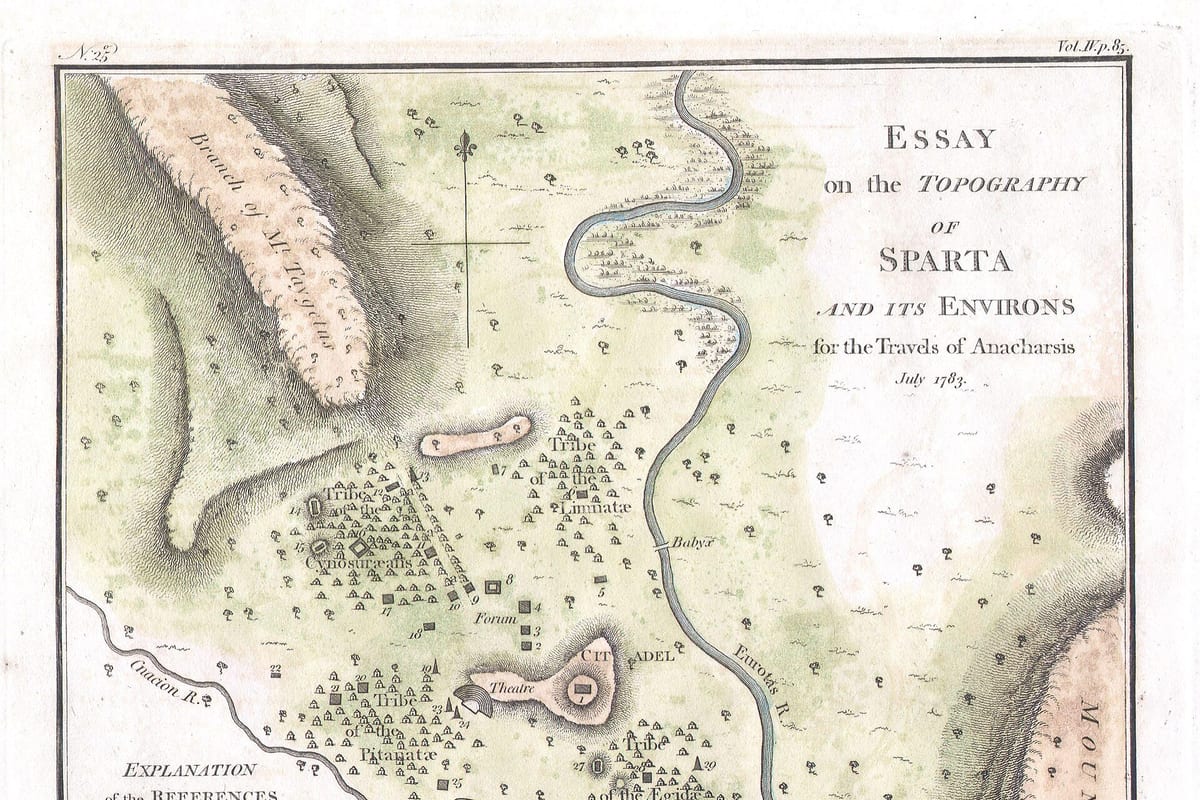
Sparta sat in the Eurotas valley in the southeastern Peloponnese. It was not a walled city — Spartans said their army was the wall — so what remains today is scattered rather than dramatic. The Spartan state rose to prominence around 700 BC, dominated Peloponnesian politics from about 550 to 371 BC, and slowly declined until Rome absorbed it in 146 BC.
Its two royal families ruled jointly (yes, two kings at once — a peculiarity that survived for centuries). Real power lay with a council of 28 elders and five annually elected magistrates called ephors. It was a mixed constitution — part hereditary monarchy, part aristocracy, part democracy — that Aristotle described admiringly.
The agoge: how Spartan boys were made
Sparta’s defining institution was the agoge, the state-run system that took every free-born Spartan boy at age 7 and turned him into a warrior. Boys lived in barracks-style groups, were fed on a deliberately meagre diet (to teach them to steal, but be punished if caught — the punishment was for being caught, not stealing), toughened by physical training and beatings, taught reading, writing, singing and dance.
At age 12 boys received only one cloak per year and had to sleep on reed beds they cut themselves. At 18 they became eirenes — junior soldiers who commanded younger boys. At 20 they entered the mess (syssitia) where they would eat every meal until age 60. At 30 they became full citizens with the vote in the assembly.
Girls received a different but also unusual education. Spartan girls trained in athletics, wrestling and javelin — visible in public and physically strong. They married later than other Greek women (around 18-20 rather than 12-14), and Spartan wives had genuine authority in the household, since husbands were rarely home. Spartan women were probably the most powerful in the ancient Greek world.
The helots
Sparta’s dark secret was its economy. Around 700 BC, Sparta conquered its neighbour Messenia and reduced the entire Messenian population — perhaps 200,000 people — to state-owned agricultural slaves called helots. Helots outnumbered Spartan citizens by perhaps 20 to 1. They worked the land, produced the food, and delivered a fixed portion of every harvest to their Spartan masters.
The relationship was uniquely brutal. Every year the ephors formally declared war on the helots so that any Spartan could kill any helot without incurring religious pollution. The krypteia was a secret police made up of young Spartan warriors who lived rough in the countryside and murdered any helot who looked ambitious.
This is the paradox at the heart of Sparta. The state’s obsessive militarism was a rational response to the security problem of holding down a slave majority twenty times bigger than itself. Every Spartan man had to be a soldier because if the helots ever rose in coordinated revolt, they would win.
What Spartans did all day
Adult male Spartans did almost no productive work — that was what the helots were for. Their daily life was:
- Military training and drill
- Hunting
- Athletic training
- Attending the mess for meals
- Political participation in the assembly
- Overseeing helots working their allocated estate
The famous “Spartan mess” — syssitia — was central. Every Spartan citizen ate all his meals with a mess group of around 15 men for his entire adult life. Attendance was mandatory. The mess contribution was mandatory too — a Spartan who could no longer contribute (typically through impoverishment) lost his citizenship.
Family life was minimal by Greek standards. Newly married Spartan men continued to live in the barracks and had to sneak visits to their wives. Only at 30 could they set up an actual household. Even then, they ate every night in the mess.
What Spartans fought like
Spartan hoplites (heavy infantry) were the most respected soldiers in the ancient Greek world. They fought in the phalanx formation — a tightly packed rectangle of shields with spears projecting outward, moving as one unit. Their advantage was not superior weapons (every Greek hoplite had roughly similar equipment) but drill. Spartans spent 20 years training for the phalanx; Athenians spent maybe two weeks a year.
The 300 Spartans at Thermopylae (480 BC) are the famous example, but the more decisive battles were at Plataea (479 BC, where they broke the Persian army and effectively ended the invasion) and at Leuctra (371 BC, where the Theban general Epaminondas finally broke the Spartan phalanx and Spartan hegemony collapsed within a generation).
The decline
Sparta’s system depended on maintaining a large citizen army, but its rules meant citizenship shrank over generations. Citizens who lost their land, could not contribute to the mess, or died in battle without heirs lost the family line from the roll. From about 8,000 citizens in 480 BC, the total shrank to perhaps 1,000 by 371 BC. The defeat at Leuctra ended Spartan dominance; the state limped on for centuries but never mattered strategically again.
Rome took Greece in 146 BC. Sparta lasted under Rome as a semi-independent theme park, playing up its exotic reputation for wealthy Roman tourists who came to see boys being ceremonially whipped at the Temple of Artemis Orthia.
What survives today
Sparta’s determination not to build monumental architecture (they thought it was decadent) means the site is one of the least dramatic in Greece. But it is still worth going, especially for the museum:
- Modern Sparta town (called Sparti) — pleasant provincial town with a very good Archaeological Museum
- Ancient acropolis — modest ruins including the Roman theatre and temple of Athena Chalkioikos
- Menelaion — Mycenaean-era ruins associated with Menelaus and Helen, on a hilltop east of the city with excellent Eurotas valley views
- Temple of Artemis Orthia — where the ephebe-flogging ritual took place. Ruins are modest but the setting is atmospheric
- Mystras — 5 km west of Sparta, a spectacular Byzantine ghost town clinging to the flank of Mount Taygetos. UNESCO World Heritage. If you make the trip to Sparta, Mystras is the real reason to come
See our Greece travel guide for logistics and pair with our post on Athens.
Frequently asked questions
How many Spartans were there?
What was the agoge?
Who were the helots?
Did the 300 Spartans really exist?
Why did Sparta decline?
What can you actually see at Sparta today?