The doctrines that heaven and hell exist, that history has a moral direction, that angels and demons wage a cosmic battle, and that a saviour will come at the end of time — none of these ideas started with Judaism, Christianity or Islam. They started with a Persian prophet named Zarathustra (better known to the West as Zoroaster), somewhere between 1500 and 1000 BC.
Zoroastrianism is possibly the world’s oldest continually practiced monotheistic religion. It is still practiced today by an estimated 100,000 to 200,000 people worldwide, most of them in India and Iran. Here is its history, its influence, and where you can still see it. See our Iran travel guide for context.
Who Zoroaster was
Zarathustra Spitama, the prophet, is hard to date precisely. Linguistic evidence for the earliest Zoroastrian hymns (the Gathas) puts him somewhere between 1500 and 1000 BC — making him roughly contemporary with Moses, or possibly earlier. He probably lived in what is now northeastern Iran or Central Asia. His father was a priest of the older Iranian polytheism; Zarathustra broke with that tradition.
According to tradition, Zarathustra received a divine vision at 30, spent the next ten years being rejected by his own community, and finally won a convert in an eastern king named Vishtaspa. From this base the new religion spread.
What Zoroaster taught
Six ideas made Zoroastrianism radically different from the polytheism around it:
- Monotheism. There is one supreme god, Ahura Mazda (“Wise Lord”), creator of all that is good.
- Cosmic dualism. Ahura Mazda is opposed by Angra Mainyu (later called Ahriman), the destructive spirit — the source of all evil. The two are locked in a battle that will end with Ahura Mazda’s victory.
- Free will. Every human being must choose which side to serve. Ethics is a choice, not a fate.
- Judgment of the soul. After death, the soul crosses the Chinvat Bridge. For the righteous, the bridge broadens and welcomes them into paradise. For the wicked, it narrows to a razor’s edge and they fall into a place of torment.
- Bodily resurrection and final judgment. At the end of history, a saviour figure (the Saoshyant) will bring the dead back to life for a final universal judgment. The good will live forever; evil will be destroyed.
- Ritual purity, especially of fire, water and earth. Zoroastrians treat these elements as sacred and do not pollute them. This is why the dead are exposed on “towers of silence” for vultures rather than buried or cremated.
Compared to the religions around it in 1000 BC — Egyptian polytheism, Mesopotamian polytheism, the early Vedic religion of India — this was startlingly modern.
The Persian state religion
Zoroastrianism became the state religion of the Achaemenid Persian Empire under Darius I (522-486 BC). Darius’ rock inscriptions repeatedly invoke Ahura Mazda: “By the grace of Ahura Mazda, I am king.” The empire’s official policy tolerated other religions (see our Persian Empire post on Cyrus’s treatment of the Jewish exiles), but the ruling dynasty was Zoroastrian.
When Alexander burned Persepolis in 330 BC, he destroyed most of the sacred Zoroastrian texts, which had been kept in the royal library. What survives is a small fraction of what once existed. The tradition was preserved orally by priests until it was written down again in the Sasanian era (3rd-7th century AD).
Influence on Judaism, Christianity and Islam
The Jewish elite spent 50 years (587-539 BC) in Babylonian captivity, and then another 200 years living under tolerant Persian rule after Cyrus liberated them. During this period, Jewish religion absorbed a striking number of Zoroastrian concepts that had not been present in the earlier Hebrew scriptures:
- An organised system of angels and demons (unknown in early Judaism)
- Satan as a distinct personified enemy of God
- The idea of a future messiah who would bring the resurrection of the dead
- Heaven and hell as post-mortem destinations tied to moral behaviour
- A final judgment ending history
- Cosmic dualism between forces of good and evil
These ideas appear in later Jewish texts (Ezekiel, Daniel, apocalyptic literature) but not in earlier ones (the Torah). They are all inherited into Christianity (which is dualistic and eschatological to the core) and Islam (which likewise has angels, demons, heaven, hell and a final judgment).
The three Magi in the Christmas story are Zoroastrian priests (magi is literally the Old Persian word for Zoroastrian priest). Their gift of frankincense and myrrh is characteristic of Zoroastrian fire-temple ritual.
The Sasanian revival
After Alexander, Persia was ruled by Greek Seleucids and then by the Parthians, both of whom tolerated Zoroastrianism but did not particularly promote it. In 224 AD the Sasanian dynasty took over and made Zoroastrianism the state religion again, a status it held for the next 400 years.
Sasanian priests compiled the surviving oral traditions into what became the Avesta, the Zoroastrian scripture. Sasanian art and architecture — palaces at Ctesiphon and Firuzabad, rock reliefs at Naqsh-e Rustam — show fire altars and Ahura Mazda’s symbol everywhere.
The Islamic conquest and after
Arab armies conquered Sasanian Persia between 636 and 651 AD. Islam gradually replaced Zoroastrianism as the majority religion over the next 300 years, sometimes through pressure and sometimes through voluntary conversion (many Zoroastrians could not afford the extra tax levied on non-Muslims).
A group of Zoroastrians fled to India in the 9th century, settling in Gujarat and later Mumbai. Their descendants — the Parsis (literally “Persians”) — remain influential in Indian business and public life. The Tata industrial family, the Godrej group and the Wadia group are all Parsi. Freddie Mercury was a Parsi born in Zanzibar.
The Zoroastrians who stayed in Iran shrank to a small minority, currently around 25,000-40,000, concentrated in Yazd and Kerman.
Where to see it today
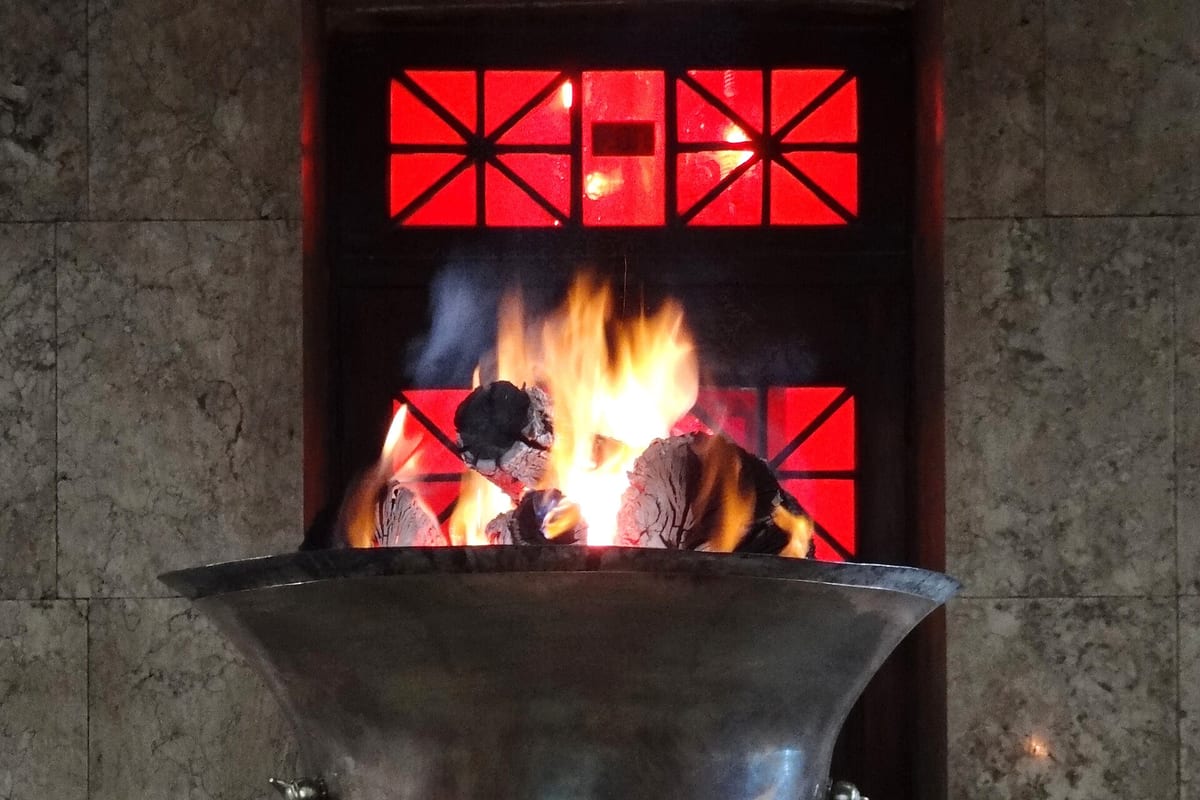
- Yazd, Iran — the current heartland. The Atashkadeh fire temple in Yazd holds a flame that has been continuously burning since 470 AD. The nearby Towers of Silence (dakhma) on hills outside the city are no longer used but are open to visit.
- Chak Chak, Iran — a Zoroastrian pilgrimage site in the desert north of Yazd, built into a cliff around a sacred spring
- Naqsh-e Rustam, Iran — Sasanian rock reliefs show fire altars and coronation scenes with Ahura Mazda
- Persepolis, Iran — Achaemenid reliefs invoke Ahura Mazda; see our Persepolis post
- Mumbai, India — the Parsi community holds several fire temples (non-Parsis usually cannot enter) plus the Doongerwadi Towers of Silence
- British Museum, London — Zoroastrian material in the Iranian gallery
See our Iran travel guide and India guide for logistics.
Frequently asked questions
What is Zoroastrianism?
How did Zoroastrianism influence Judaism, Christianity and Islam?
How many Zoroastrians are there today?
What do Zoroastrians actually believe?
Do Zoroastrians worship fire?
Where can I visit Zoroastrian sites today?