Alexander the Great died in 323 BC. His empire fragmented within decades. But the cultural change he set in motion — Greek as the working language of the eastern Mediterranean, Middle East and even parts of Central Asia — lasted for 700 years. This is the Hellenistic world.
The Hellenistic era (roughly 323 BC to 30 BC, when the last Hellenistic kingdom fell to Rome) is when Greek science reached its peak, when the largest cities in the world were Greek-founded, and when a distinctive urban civilisation ran from Marseille to Kandahar. Here is what it looked like and what survives. See our Alexander post for the setup.
The successor kingdoms
When Alexander died in Babylon without a clear heir, his generals — the Diadochi (“successors”) — spent 40 years fighting over the empire. By around 280 BC, it had settled into four main kingdoms:
- Ptolemaic Egypt — capital Alexandria, ruled by descendants of Alexander’s general Ptolemy for 275 years, ending with Cleopatra VII in 30 BC (see our Cleopatra post)
- Seleucid Empire — the biggest, running from Syria across Iran to Central Asia and initially into India. Founded by Alexander’s general Seleucus. Slowly ate itself alive over 250 years, ending in Roman conquest of Syria in 63 BC
- Antigonid Macedon — Alexander’s original homeland, ruled by descendants of Antigonus. Conquered by Rome in 168 BC
- Attalid Pergamon — spun off from the Seleucids around 262 BC. Bequeathed to Rome in 133 BC by its last king Attalus III
The Hellenistic city
The successor kings founded cities on the same template everywhere they went. A Greek-style urban plan (rectangular grid), an agora (marketplace with covered stoas), a gymnasium (for education and athletics), a theatre (for drama), a bouleuterion (council chamber), temples to both Greek gods and local deities. This urban template ran from Sicily to the Indus.
Some of these cities became genuinely huge. Alexandria in Egypt had about 500,000 people at its peak. Antioch in Syria had around 300,000. Seleucia on the Tigris in Iraq (built to replace Babylon as Mesopotamia’s administrative capital) had over 100,000. In the 3rd century BC, more Greek-speaking people probably lived outside mainland Greece than inside it.
Alexandria: the intellectual capital
Alexandria was the largest and most important Hellenistic city. Its Ptolemaic kings sponsored the Library and the Musaeum — effectively the ancient world’s first university and research institute (see our Alexandria post).
Alexandrian scholars produced the foundational work of Western science:
- Euclid — wrote the Elements, the geometry textbook still partially in use today
- Eratosthenes — calculated the Earth’s circumference to within 2%
- Aristarchus of Samos — proposed a heliocentric model of the solar system, 1,700 years before Copernicus
- Herophilus and Erasistratus — the first Western anatomists, first to dissect human bodies
- Archimedes of Syracuse — studied at Alexandria before returning to Sicily
- Hipparchus — invented trigonometry, catalogued 850 stars
- Ctesibius — invented the pipe organ, the water clock, pneumatic devices
Pergamon: the second capital
Pergamon (near modern Bergama in western Turkey) was the capital of the Attalid dynasty. Deliberately built to rival Alexandria, its library had 200,000 volumes and its Great Altar (now in Berlin’s Pergamon Museum) is one of the most spectacular works of Hellenistic art anywhere. Parchment — pergamene in Latin — is named after Pergamon, because when Ptolemaic Egypt embargoed papyrus exports to keep Pergamon’s library growth in check, Pergamene scribes had to develop an alternative writing surface.
The Attalids bequeathed the whole kingdom to Rome in 133 BC. The site can be visited today from Izmir; the acropolis is one of Turkey’s most spectacular ancient ruins.
Ai Khanoum: Greek civilisation on the Oxus
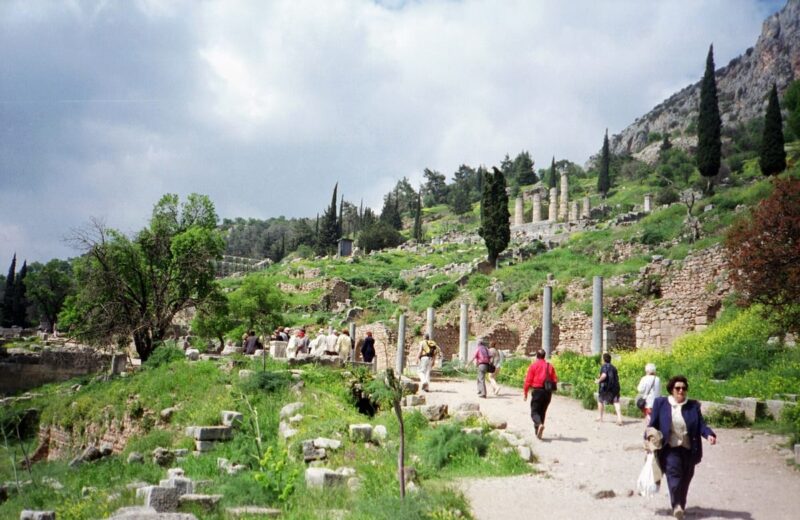
The most surprising Hellenistic city sits in northern Afghanistan at Ai Khanoum (“Lady Moon” in modern Uzbek) on the Amu Darya river (ancient Oxus). Founded either by Alexander himself or by Seleucus around 300 BC, it had all the standard Greek features — theatre, gymnasium, temples with Greek columns — 5,000 km from Greece proper. Its philosophical texts inscribed in Greek were as much at home there as in Athens.
Ai Khanoum was destroyed by nomadic invasions around 145 BC and forgotten. French archaeologists excavated it between 1965 and 1978 before civil war closed access. The site has been looted heavily since; many of its treasures have surfaced on the antiquities market. The finds that made it to Kabul museum before the war are among the most striking artifacts of Hellenistic culture anywhere.
Hellenistic India: Gandhara
Alexander’s troops crossed the Indus. Hellenistic culture followed, most strikingly in Bactria (northern Afghanistan and Uzbekistan) and Gandhara (northern Pakistan and eastern Afghanistan). The Indo-Greek kings ruled parts of this region until about 10 BC — one of them, Menander I, became a serious patron of Buddhism and appears in Buddhist scripture as “King Milinda”. Greek-Buddhist syncretism produced the Gandhara school of art, which gave us the first anthropomorphic depictions of the Buddha — carved in stone, wearing draped robes that look strikingly like Greek togas, in the 1st and 2nd centuries AD.
You can see Gandharan Buddhas in the Peshawar Museum (Pakistan), the Kabul Museum (Afghanistan, ISIS damage), the British Museum, the Metropolitan Museum of Art and the Musée Guimet in Paris.
The end
Rome absorbed the Hellenistic kingdoms one by one over 200 years: Macedon in 168 BC, Pergamon in 133 BC, Seleucid Syria in 63 BC, Egypt in 30 BC. But Greek culture kept dominating the eastern half of the Roman Empire — Greek stayed the language of educated Romans, the New Testament was written in Greek, and Byzantine (the eastern Roman Empire) was fundamentally Greek-speaking until Constantinople fell in 1453 AD.
In real terms, Hellenistic culture — Alexander’s legacy — outlasted its founder by 1,700 years.
Where to see the Hellenistic world today
- Alexandria, Egypt — Roman theatre, catacombs, Fort Qaitbey on the Pharos foundations, Bibliotheca Alexandrina
- Pergamon, Turkey — acropolis, theatre, temples, library foundations; the Great Altar is in Berlin’s Pergamon Museum
- Ephesus, Turkey — Roman-imperial period city that grew from Hellenistic roots; one of the best-preserved ancient sites in the world
- Priene, Turkey — a beautifully preserved smaller Hellenistic city on a defensible hillside, laid out on the classic grid pattern
- Aphrodisias, Turkey — Hellenistic-Roman city famous for its sculpture school
- Delos, Greece — trading hub of the Hellenistic Aegean, extensive ruins on an uninhabited island near Mykonos
- Palmyra, Syria — caravan city with strong Hellenistic influence (extensively damaged by ISIS 2015-16)
- Gandhara sites, Pakistan / Afghanistan — Taxila, Peshawar Museum; Bamiyan (Buddhas destroyed 2001, niches remain)
- Berlin Pergamon Museum — the Great Altar of Pergamon, still one of the greatest single objects ever moved to a European museum
See our Turkey, Egypt and Greece travel guides for planning.
Frequently asked questions
What was the Hellenistic period?
How far east did Hellenistic culture spread?
What were the four main Hellenistic kingdoms?
What did Hellenistic Greek science actually achieve?
What language did Hellenistic people speak?
Where can I visit Hellenistic sites today?