Alexander III of Macedon crossed the Hellespont in the spring of 334 BC with about 35,000 soldiers and roughly 70 talents of silver — enough to pay his army for a month. He was 22 years old. By the time he died in Babylon 11 years later, in June 323 BC, he was master of an empire running from Greece to the Indus valley — about 5.5 million square kilometres, roughly the size of the continental United States. No individual has expanded a state’s territory faster before or since.
Here is what he actually did, why it worked, and what still stands where he built cities. See our history of ancient Greece for context.
The setup
Alexander inherited a strong hand. His father Philip II (359-336 BC) had spent 20 years turning Macedon from a backward frontier kingdom into a first-rate military power. Philip invented the modern professional army: a full-time paid infantry armed with the sarissa (a 6-metre pike, twice the length of a normal Greek spear), backed by shock cavalry and combined-arms tactics. He then used this army to bring the traditionally independent Greek city-states under Macedonian control.
Philip planned to invade Persia to “liberate” the Greek cities of Asia Minor. He was assassinated at his daughter’s wedding in 336 BC before he could launch the campaign. Alexander, 20 years old, took the throne, spent two years crushing rebellions in Greece and the Balkans, and then set out to do what his father had planned.
Battle of Granicus (334 BC): the opener
The first significant Persian force met Alexander at the Granicus river in northwestern Turkey. Alexander led a cavalry charge personally, was almost killed when a Persian noble split his helmet with an axe, but was saved by his general Cleitus. Result: Persian defeat, Alexander in command of Asia Minor.
Instead of pushing on immediately, he spent two years methodically reducing the coastal cities of Asia Minor — some by siege (Halicarnassus, Miletus), some by negotiated surrender. He cut off the Persian navy by taking its bases rather than fighting it at sea. This was strategically brilliant and won him the eastern Mediterranean without a naval battle.
Battle of Issus (333 BC): defeating the king
King Darius III of Persia (a distant cousin who had recently taken the throne in a coup) took the field personally at Issus in southeastern Turkey. Persian numbers were larger — perhaps 100,000 to Alexander’s 40,000. Darius chose the terrain badly, hemming his own army into a narrow coastal plain where superior numbers could not be brought to bear.
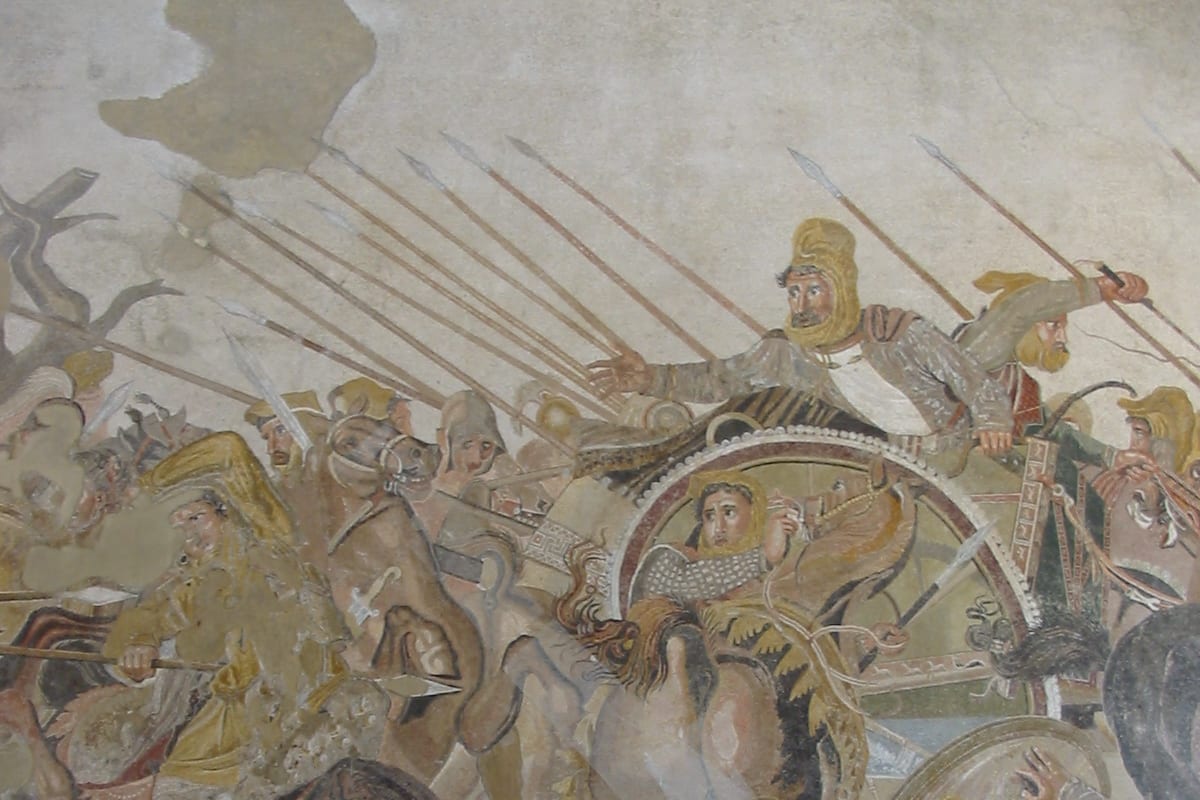
Alexander led a direct cavalry charge at Darius himself. Darius fled, abandoning his tent, his baggage, his wife and children. Alexander captured all of it, treated the royal family with courtesy (his mother Sisygambis became a family friend), and now controlled the entire Levant.
Egypt and Alexandria (332-331 BC)
Alexander marched south down the Levant coast, taking Tyre after a spectacular seven-month siege that involved building a causeway out to the island fortress (still there — Tyre is a peninsula today because of Alexander’s causeway). Gaza was next. Egypt then opened its gates without a battle — Persia had been an unpopular occupier, and Alexander was welcomed as a liberator.
He was crowned pharaoh at Memphis, made a pilgrimage to the oracle of Amun at Siwa in the western desert (where the priests confirmed he was the son of god — a claim he took increasingly seriously as the years wore on), and founded the city of Alexandria on the Mediterranean coast (see our Alexandria post).
Battle of Gaugamela (331 BC): the final blow
Darius rebuilt his army, this time with cavalry from the eastern provinces and 200 scythed chariots. He chose flat ground near Gaugamela in northern Iraq where numbers could tell.
Alexander used the ground against him. He extended his line so far that Darius, to prevent being outflanked, had to shift his cavalry sideways — opening a gap in his own centre. Alexander plunged into the gap with his elite Companion cavalry and went straight for Darius, who fled again. The Persian centre collapsed. Alexander now had the empire.
Persepolis burned (330 BC)
Alexander occupied Susa (administrative capital) and Persepolis (ceremonial capital) in early 330 BC. He deliberately burned Persepolis, probably in revenge for Xerxes’ burning of Athens 150 years earlier. Darius III was murdered by his own commanders while fleeing east; Alexander gave him a state funeral and executed the murderers.
Alexander was now Great King of Persia — a title he took seriously. He began wearing Persian court dress, married a Persian noblewoman (Roxana, from Bactria), and integrated Persian nobles into his army. His Macedonian officers hated it. Several plots were uncovered. Alexander executed old comrades including his historian Callisthenes.
Central Asia and India (329-326 BC)
Alexander spent three years subduing Central Asia — modern Afghanistan, Tajikistan, Uzbekistan — some of the hardest fighting of the campaign. Then in 327 BC he crossed the Hindu Kush into what is now Pakistan.
He beat the local king Porus at the Battle of the Hydaspes (326 BC) in a monsoon downpour, using rafts to cross the flooded river. Porus fought bravely on his war elephant; Alexander, impressed, gave him his kingdom back as a vassal.
At the Hyphasis river, Alexander wanted to continue east. His army finally refused. They had been marching for eight years. They wanted to go home. Alexander sulked in his tent for three days, then reluctantly agreed to turn back.
Death in Babylon (323 BC)
Alexander marched south down the Indus, then west across the Makran desert (a horrific desert crossing that killed thousands), then back to Babylon by 324 BC. He was making plans for further campaigns — the Arabian peninsula, Carthage, the western Mediterranean — when he fell ill after a heavy drinking session in June 323 BC and died 10 days later. He was 32.
Cause of death is disputed. Options: malaria, typhoid, poisoning, alcoholism, West Nile virus, the accumulated effect of multiple untreated wounds. Modern medical opinion tends toward typhoid.
What Alexander actually changed
His empire fragmented within decades — his generals divided it into successor kingdoms (Ptolemaic Egypt, Seleucid Syria/Persia, Antigonid Macedon, Attalid Pergamon). But the cultural change he set in motion outlasted the political structure by centuries. Greek became the common language of the eastern Mediterranean and Middle East for the next 700 years. Cities founded on Greek models were built as far east as Alexandria on the Oxus (in modern Afghanistan). The Hellenistic era of Greek science, philosophy, and art — the world of Euclid, Archimedes, Eratosthenes — flowered in cities Alexander had founded.
Where to see Alexander today
- Pella (northern Greece) — Alexander’s birthplace, extensive Macedonian palace ruins with famous mosaics
- Vergina (Aigai) — tomb of Philip II (Alexander’s father) with the gold ossuary still on display
- Alexandria (Egypt) — the city he founded (see our Alexandria post)
- Persepolis (Iran) — the city he burned (see our Persepolis post)
- Babylon (Iraq) — where he died
- Naples Archaeological Museum — the Alexander Mosaic from Pompeii, showing him at the Battle of Issus, is the most famous ancient portrait of him
- Istanbul Archaeological Museum — the “Alexander Sarcophagus” (actually made for a Sidonian king who fought for Alexander) with the finest surviving Hellenistic reliefs
See our Greece, Egypt and Iran travel guides for planning.
Frequently asked questions
How old was Alexander the Great when he died?
How big was Alexander’s empire?
What killed Alexander the Great?
Did Alexander really cry when he had no more worlds to conquer?
What happened to Alexander’s empire after he died?
Where can you see Alexander’s tomb?